Select the correct word:
Verb To Be Explanation & Exercises

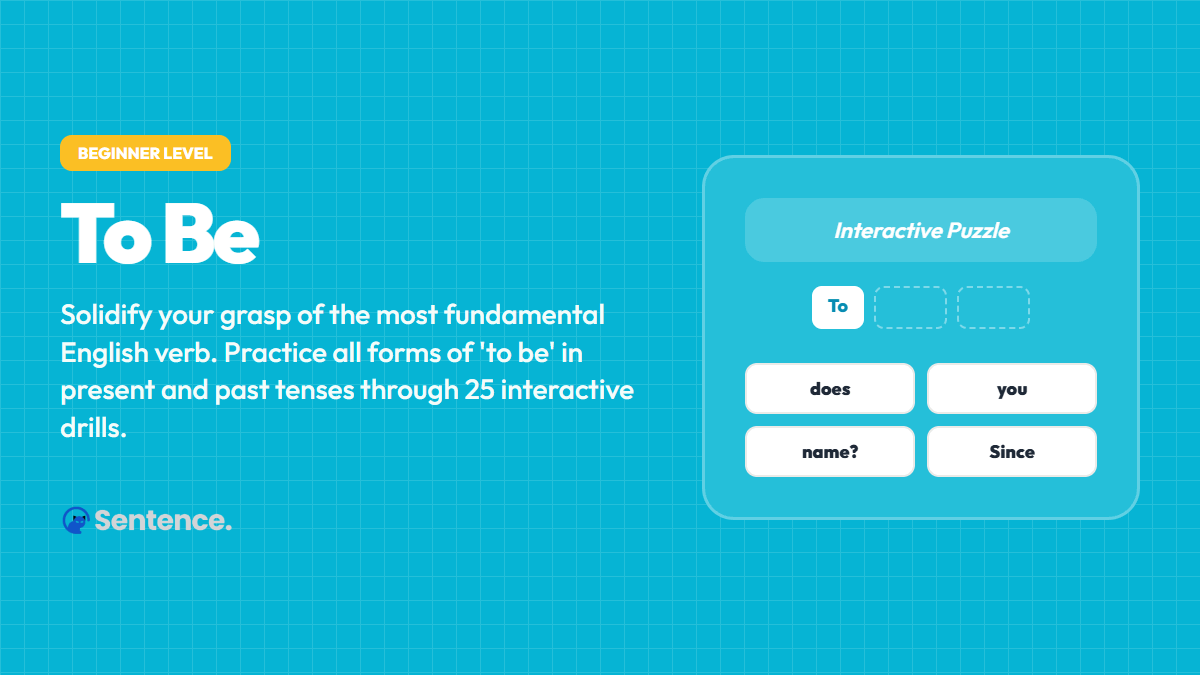
What is To Be?
To be is one of the most basic and most useful verbs in English. Even if you are still beginner level, you already use it in daily speech: introductions, short chats, class activities, and messages. Sentences like I am ready, She is at home, and They are excited all use this verb.
We use to be to connect a subject with information about identity, condition, or location. In grammar, this is called a linking verb. It does not show action like "run" or "eat". Instead, it tells us what someone or something is, how they feel, or where they are.
This topic is very important because it appears almost everywhere in English. If your to be usage is correct, your basic sentence quality improves fast. If it is wrong, even simple sentences sound awkward. So learning this verb well is not a small step. It is a strong foundation for almost every next grammar topic.
You will usually see these forms: am / is / are for present and was / were for past. The correct form depends on the subject and time. Once you build this habit, your speaking and writing will feel more natural.
Structure (Form)
The form of to be changes based on two core things: subject and tense. Before choosing an answer, always ask: "Who is the subject?" and "Is this present or past?" This simple check prevents most grammar mistakes.
After that, check sentence type: positive, negative, or question. The same verb follows a different pattern in each type. For example, positive is "Subject + be + complement", negative adds not, and question moves the verb before the subject.
| Type | Pattern | Example |
|---|---|---|
| Positive | Subject + be + complement | She is a teacher. |
| Negative | Subject + be + not + complement | They are not ready. |
| Question | Be + subject + complement? | Are you okay? |
Subject matching is the most important part. Use am with I, is with singular subjects, and are with plural subjects plus you. For past forms, use was for singular subjects and were for plural subjects plus you.
| Subject | Present | Past |
|---|---|---|
| I | am | was |
| He / She / It | is | was |
| You / We / They | are | were |
In daily English, contractions are common too: I'm, he's, we're, they're, isn't, aren't, wasn't, weren't. Learning both full forms and contractions helps you understand both formal writing and casual conversation.
When to Use To Be
Use to be when your sentence gives information about a person, thing, or situation, not an action. Below are the most common uses in daily English, with extra examples so the pattern is easier to remember.
1) To Show Identity
Use this when you introduce someone, say who a person is, or explain a role. This pattern is common in classrooms, meetings, interviews, and simple self-introductions.
- I am Rina.
- He is my classmate.
- She is our new manager.
In these sentences, the verb does not show an action. It connects the subject with identity information.
2) To Describe Condition or Feeling
Use this when you describe temporary condition, mood, or physical state. This is one of the most natural uses in daily conversation.
- I am tired today.
- She is happy now.
- They are busy this afternoon.
These words (tired, happy, busy) describe a state. Because the sentence is descriptive, to be is required.
3) To Show Location
Use this when you say where people or things are. This is very common in directions, daily plans, and simple updates.
- We are in the library.
- The keys are on the table.
- My phone is in my bag.
Location sentences usually answer "Where?". If you are giving location information, to be is often the correct verb.
4) To Describe Past State
Use was and were for situations that happened in the past. Time words like "yesterday" or "last night" usually indicate this form.
- He was at home last night.
- They were busy yesterday.
- We were excited before the exam.
If the condition or location is finished and in the past, switch from present forms to was/were.
Quick check before answering: if your sentence answers Who?, Where?, or How is it?, you probably need to be.
Examples
These grouped examples help you see the same grammar pattern in different sentence types.
Present Statements
- I am a student.
- She is kind.
- They are ready.
Use for current facts and descriptions.
Past Statements
- I was at home.
- He was late.
- We were in class.
Use for finished situations in the past.
Negative Sentences
- She is not angry.
- They were not at school.
- We are not busy.
Add not after the verb.
Questions
- Are you free now?
- Was he your teacher?
- Were they in the office?
Move be before the subject.
In daily conversation, contractions are common: I'm, he's, they're, isn't, aren't, wasn't, weren't.
Common Mistakes
These are common mistakes learners make with to be. Use this section as a quick self-check before submitting answers.
1) Subject and Verb Do Not Match
Wrong: They is happy.
Correct: They are happy.
Plural subjects need are in present tense.
2) Missing To Be in Description Sentences
Wrong: She happy.
Correct: She is happy.
In English, description sentences need a linking verb.
3) Wrong Past Form
Wrong: We was late.
Correct: We were late.
Was is for singular. Were is for plural and you.
4) Wrong Question Order
Wrong: You are ready?
Correct: Are you ready?
In standard grammar, put be before the subject in questions.
Fast correction habit: check subject first, tense second, then sentence type. This one habit fixes most mistakes.
Practice Exercises (Grammar Game Guide)
In this grammar game, each item gives you a sentence context and answer options. Your goal is to choose the correct to be form (am / is / are / was / were) based on subject, tense, and sentence type. Think of it as a fast decision drill, not just a quiz.
A simple way to play each item: read the full sentence first, find the subject, check time clues, then choose the form that fits naturally. If the sentence sounds smooth when you read it again, you are usually on the right track.
Tips for better accuracy:
- Check subject first (I / he / they).
- Check time word (today, now, yesterday, last night).
- Check sentence type (positive, negative, or question).
- Re-read your final sentence before submit.
What you will get from this practice:
- Faster grammar decisions when speaking and writing.
- Fewer subject-verb agreement mistakes.
- Better confidence with basic English sentence patterns.
- Stronger foundation for harder grammar topics later.
If you repeat this process across many items, the correct form starts to feel automatic. That is the main win of this game: you build grammar reflex, not just temporary memory.
Master the fundamental forms of "to be" through 25 interactive activities. Practice present and past tenses with instant feedback and detailed patterns.

asasa