Select the correct word:
Idioms Explanation & Exercises
What are Idioms?
Idioms are fixed expressions whose meaning is different from the literal meaning of each word. You cannot always understand them by translating word by word.
Example: break the ice means start conversation in a friendly way, not physically breaking ice.
Idioms are common in casual conversation, social media, movies, and storytelling. Learning them improves listening comprehension and makes your English feel more natural.
Idioms encode cultural and contextual meaning, so understanding them improves real-world listening and pragmatic comprehension beyond literal vocabulary knowledge.
They are most effective when used selectively in suitable register. Correct context choice matters as much as knowing the idiom meaning itself.
Structure (Form)
Idioms are usually fixed chunks. You often cannot replace one word with a synonym without changing or breaking meaning.
Some idioms are full clauses, others are short phrases. Most are semi-formal or informal, so context and tone matter.
| Idiom | Meaning | Example |
|---|---|---|
| hit the books | study hard | I need to hit the books tonight. |
| once in a blue moon | very rarely | We meet once in a blue moon. |
| piece of cake | very easy | The quiz was a piece of cake. |
| spill the beans | reveal secret information | He spilled the beans about the surprise. |
| Usage Aspect | Guideline |
|---|---|
| Fixed wording | Do not change key words randomly. |
| Context | Choose idiom that fits situation and tone. |
| Register | Most idioms are best in informal/semi-formal contexts. |
| Clarity | Avoid overusing idioms in one paragraph. |
When to Use Idioms
Use idioms when you want natural, expressive language in friendly communication. Use them carefully in formal writing.
1) Casual Conversation
Use this pattern in Idioms when the sentence goal fits Casual Conversation. Focus on the meaning first, then choose the correct form so the sentence sounds natural in real context.
- Let's call it a day.
- I'm feeling under the weather.
- No worries, we'll figure it out.
2) Storytelling and Emotional Expression
Use this pattern in Idioms when the sentence goal fits Storytelling and Emotional Expression. Focus on the meaning first, then choose the correct form so the sentence sounds natural in real context.
- She was on cloud nine after the result.
- I was over the moon when I got accepted.
- He kept his cool during the interview.
3) Friendly Writing and Social Media
Use this pattern in Idioms when the sentence goal fits Friendly Writing and Social Media. Focus on the meaning first, then choose the correct form so the sentence sounds natural in real context.
- This update is a game changer.
- That tip saved my day.
- The event was packed to the brim.
4) Advice and Motivation
Use this pattern in Idioms when the sentence goal fits Advice and Motivation. Focus on the meaning first, then choose the correct form so the sentence sounds natural in real context.
- Every cloud has a silver lining.
- Take it one step at a time.
- Don't put all your eggs in one basket.
Examples
These grouped examples show idioms by communication function.
Study Context
- I have to hit the books tonight.
- This chapter is not a piece of cake.
- We burned the midnight oil before the exam.
Useful for school-related expression.
Mood and Feeling
- I'm under the weather today.
- She is on cloud nine now.
- He feels down in the dumps.
Idioms can express emotion quickly and naturally.
Communication Situations
- Please don't spill the beans.
- Let's break the ice first.
- Cut to the chase, please.
Great for social interaction and conversation flow.
Frequency and Habit
- I eat junk food once in a blue moon.
- We hang out now and then.
- He misses class every now and then.
Idioms often replace long explanations.
Common Mistakes
These errors happen when learners treat idioms like normal literal phrases.
1) Literal Interpretation
Understanding idiom word by word.
Learn idiom as one meaning unit.
Literal translation often causes misunderstanding.
2) Changing Fixed Words
Wrong: hit the notebook
Correct: hit the books
Most idioms are fixed combinations.
3) Wrong Register
Using slangy idioms in strict academic reports.
Use neutral/formal vocabulary in formal contexts.
Choose style based on audience and purpose.
4) Overusing Idioms
Too many idioms in one paragraph.
Use idioms selectively for stronger impact.
Balanced use improves readability.
Practice Exercises (Grammar Game Guide)
In this game, items test whether you can match idioms with correct context meaning. You need to choose by intended meaning, not literal translation.
Use this strategy: read situation first, identify tone and purpose, then choose the idiom that native speakers would naturally use there.
- Focus on meaning, not word-by-word translation.
- Memorize idioms as complete chunks.
- Check whether context is casual or formal.
- Review incorrect options to build stronger intuition.
This practice improves listening, speaking fluency, and natural expression.
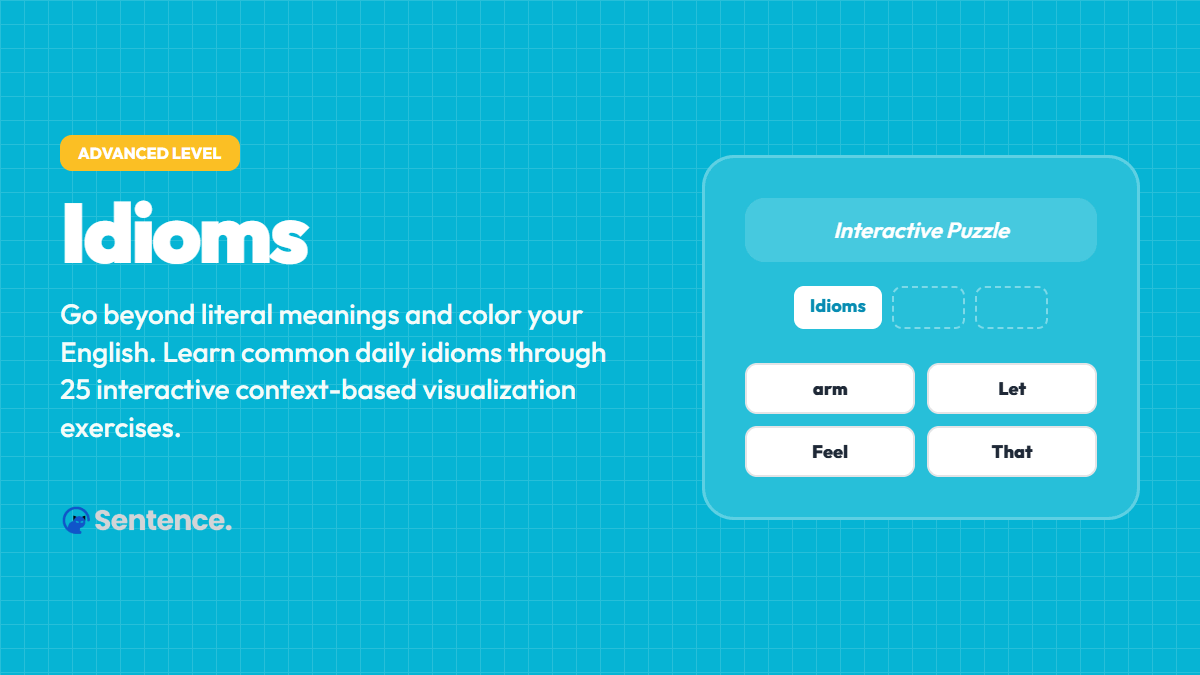
Practice with interactive exercises and improve your grammar skills step by step.

No comments yet. Be the first to share your thoughts!