Select the correct word:
Relative Clauses Explanation & Exercises

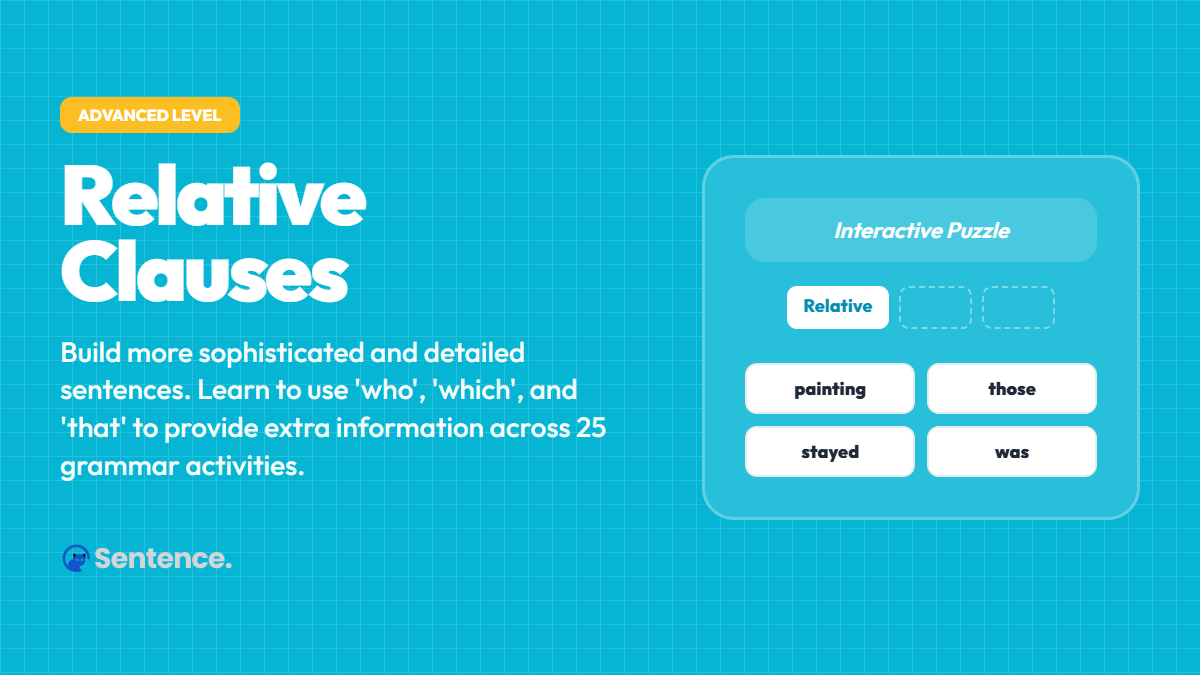
What are Relative Clauses?
Relative clauses are parts of a sentence that describe a noun. They help us join two ideas into one smoother sentence, so writing sounds less repetitive.
Example: The student who won the competition is my friend. The clause who won the competition gives extra information about the student.
Relative clauses are very useful in conversation, essays, emails, and descriptions. When used well, they make your grammar more mature and your sentence flow more natural.
Relative clauses help combine information efficiently by attaching details to nouns. This improves cohesion and reduces repetitive short sentences.
A key distinction is defining vs non-defining usage, since this affects punctuation and meaning scope. Correct clause type improves precision in explanation writing.
Structure (Form)
Relative clauses usually start with words like who, which, that, where, whose. Choose the word based on what noun you are describing: person, thing, place, or possession.
There are two main types: defining and non-defining. Defining clauses are essential for meaning. Non-defining clauses add extra detail and use commas.
| Relative Word | Used For | Example |
|---|---|---|
| who | people | The woman who called me is here. |
| which | things/animals | The book which I bought is helpful. |
| that | people or things (common) | The phone that I use is old. |
| where | places | This is the cafe where we met. |
| whose | possession | The boy whose bag was lost is sad. |
| Type | Function | Example |
|---|---|---|
| Defining | Essential information | The student who sits near me is very smart. |
| Non-defining | Extra information | My teacher, who loves music, plays guitar. |
When to Use Relative Clauses
Use relative clauses when you want to explain a noun more clearly without starting a new sentence. This helps your writing feel connected and efficient.
1) Identifying Specific People or Things
Use this pattern in Relative Clauses when the sentence goal fits Identifying Specific People or Things. Focus on the meaning first, then choose the correct form so the sentence sounds natural in real context.
- The boy who won the race is my cousin.
- The laptop that she bought is expensive.
- The class which starts at 8 is full.
2) Adding Extra Background Information
Use this pattern in Relative Clauses when the sentence goal fits Adding Extra Background Information. Focus on the meaning first, then choose the correct form so the sentence sounds natural in real context.
- My uncle, who lives in Surabaya, is visiting us.
- This app, which is free, is very useful.
- Our principal, who just returned from Singapore, gave a speech.
3) Talking About Place and Ownership
Use this pattern in Relative Clauses when the sentence goal fits Talking About Place and Ownership. Focus on the meaning first, then choose the correct form so the sentence sounds natural in real context.
- This is the room where we study every Friday.
- I met a student whose father is a pilot.
- That is the house where my grandparents grew up.
4) Improving Essay and Story Flow
Use this pattern in Relative Clauses when the sentence goal fits Improving Essay and Story Flow. Focus on the meaning first, then choose the correct form so the sentence sounds natural in real context.
- The movie that we watched last night was inspiring.
- The friend who helped me is now in college.
- The city where I was born has changed a lot.
Examples
These examples show common patterns you will see in grammar tasks.
Who / That for People
- The teacher who teaches us math is strict.
- The player that scored is famous.
- I know someone who can fix this.
Use who (or often that) for people in defining clauses.
Which / That for Things
- The bag which I bought is waterproof.
- The song that you sent is catchy.
- This is the keyboard which feels smoother.
Use which or that for things.
Where / Whose
- That is the cafe where we had lunch.
- I met a girl whose hobby is painting.
- This is the office where my mother works.
Use where for places and whose for possession.
Non-defining Clauses
- My brother, who is 18, will enter university.
- This laptop, which I bought last year, still works well.
- Mr. Adi, who teaches biology, is absent today.
Use commas for extra, non-essential information.
Common Mistakes
Watch these errors because they appear often in writing and tests.
1) Wrong Relative Word
Wrong: The woman which helped me...
Correct: The woman who helped me...
Use who for people.
2) Missing Relative Connector
Wrong: The man lives there is my uncle.
Correct: The man who lives there is my uncle.
The relative clause needs a connector word.
3) Comma Confusion
Wrong: The students, who failed the test, need support. (when not all students failed)
Correct: The students who failed the test need support.
Do not use commas in defining clauses.
4) Using That in Non-defining Clause
Wrong: My bike, that is old, still works.
Correct: My bike, which is old, still works.
In non-defining clauses, use who/which, not that.
Practice Exercises (Grammar Game Guide)
In this grammar game, each item tests your relative word choice and clause type. You need to decide whether the noun is a person, thing, place, or owner, then choose the connector that fits both grammar and meaning.
For better accuracy, check whether the information is essential (defining) or extra (non-defining). This helps you decide punctuation and connector style.
- Person: usually who.
- Thing: usually which/that.
- Place: where.
- Ownership: whose.
This practice improves sentence flow, paragraph quality, and overall writing confidence.
Build sophisticated sentences with 25 interactive Relative Clauses exercises. Master who, which, that, and where today!
No comments yet. Be the first to share your thoughts!