Select the correct word:
Possessives Explanation & Exercises
What are Possessives?
Possessives show ownership, relationship, or connection. They answer questions like "Whose is this?" and "Who does this belong to?"
English has several possessive forms: possessive nouns (Anna's book), possessive adjectives (my, your, their), and possessive pronouns (mine, yours, theirs).
If you use possessives correctly, your sentences become clearer and less repetitive.
Possessives combine grammar and punctuation. Correct apostrophe placement and pronoun-form selection directly affect meaning precision in ownership and relationship statements.
A common advanced gain is clarity in noun chains: using possessive structure correctly makes complex references easier to follow in both formal and informal writing.
Structure (Form)
For singular nouns, add 's. For plural nouns ending in s, add apostrophe only (students'). For irregular plural nouns (children, men), add 's.
Possessive adjectives come before nouns, while possessive pronouns stand alone without a following noun.
| Form Type | Pattern | Example |
|---|---|---|
| Singular noun possessive | noun + 's | Rina's laptop |
| Plural noun ending s | noun + ' | teachers' room |
| Irregular plural noun | noun + 's | children's books |
| Pronoun Group | Examples | Usage |
|---|---|---|
| Possessive adjectives | my, your, his, her, its, our, their | Used before nouns |
| Possessive pronouns | mine, yours, his, hers, ours, theirs | Used without nouns |
When to Use Possessives
1) Showing Who Owns Something
Use this pattern in Possessives when the sentence goal fits Showing Who Owns Something. Focus on the meaning first, then choose the correct form so the sentence sounds natural in real context.
- This is Rafi's notebook.
- Those are our chairs.
- Is this your phone?
2) Showing Relationship
Use this pattern in Possessives when the sentence goal fits Showing Relationship. Focus on the meaning first, then choose the correct form so the sentence sounds natural in real context.
- My sister's friend is here.
- The company's manager spoke.
- Our school's library is new.
3) Avoiding Repetition
Use this pattern in Possessives when the sentence goal fits Avoiding Repetition. Focus on the meaning first, then choose the correct form so the sentence sounds natural in real context.
- Your answer is correct. Mine is wrong.
- Their team is ready. Ours is not.
- His bag is blue. Hers is black.
4) Naming Shared Places or Resources
Use this pattern in Possessives when the sentence goal fits Naming Shared Places or Resources. Focus on the meaning first, then choose the correct form so the sentence sounds natural in real context.
- the boys' locker room
- the students' project wall
- the women's section
Examples
These examples are designed to show how Possessives works in real sentence patterns. Read each pattern first, then focus on why the structure is used in that context.
Possessive Nouns
- Leo's bicycle
- the cat's food
- my aunt's car
Add 's for singular owner.
Plural Owners
- students' uniforms
- players' training schedule
- parents' meeting room
For plural nouns ending in s, add apostrophe only.
Possessive Adjectives
- my idea
- their house
- our teacher
These forms must be followed by a noun.
Possessive Pronouns
- This laptop is mine.
- The final choice is theirs.
- Is that seat yours?
These forms replace noun phrases.
Common Mistakes
These are common mistakes learners make with Possessives. Use this section as a quick self-check before you submit your answers.
1) Confusing Its and It's
Wrong: The dog moved it's tail.
Correct: The dog moved its tail.
It's = it is / it has, not possessive.
2) Wrong Apostrophe Position
Wrong: students's projects
Correct: students' projects
Plural noun ending in s needs apostrophe only.
3) Mixing My and Mine
Wrong: This is mine bag.
Correct: This is my bag. / This bag is mine.
Adjective and pronoun forms are different.
4) Missing Possessive Marker
Wrong: Sarah phone is on the table.
Correct: Sarah's phone is on the table.
Singular owner usually needs 's.
Practice Exercises (Grammar Game Guide)
In this game, you decide which possessive form fits each sentence: noun possessive, adjective form, or pronoun form.
Use this strategy: find owner, check whether a noun follows, then choose the correct structure and punctuation.
- If noun comes after it, use possessive adjective (my, your, their).
- If no noun follows, use possessive pronoun (mine, yours, theirs).
- Check apostrophe placement carefully in noun possessives.
- Re-read sentence for ownership clarity.
This practice improves both grammar accuracy and writing punctuation quality.
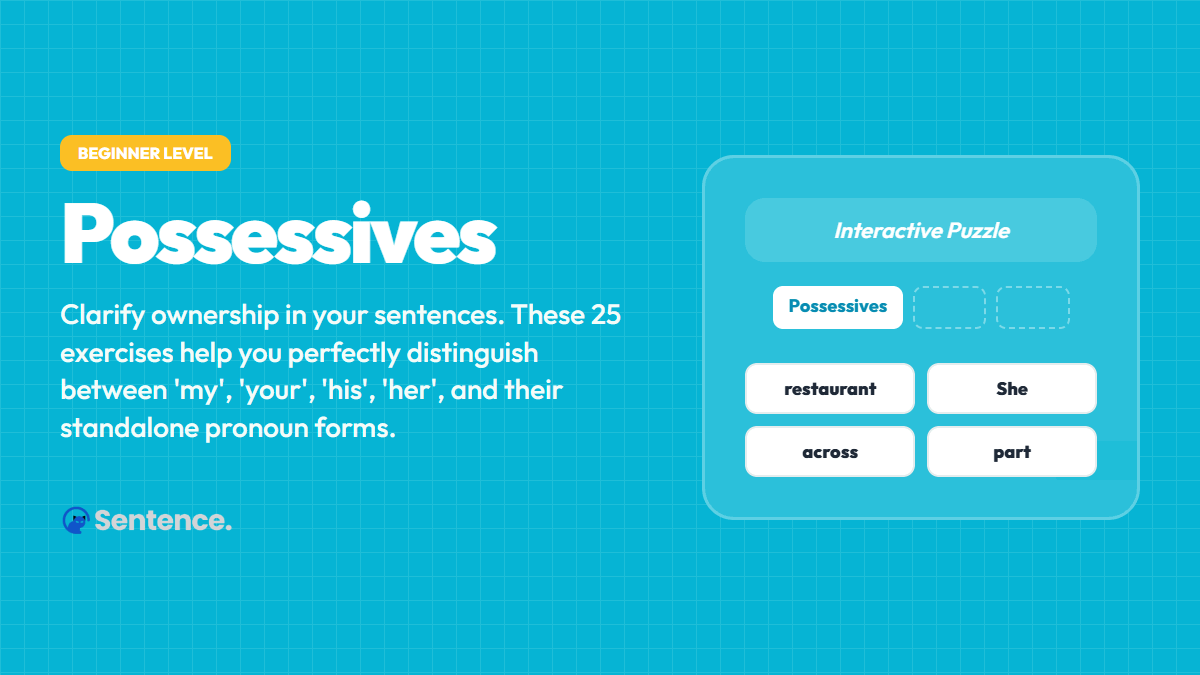
Claim what’s yours with 25 interactive Possessives exercises. Practice my, your, his, and her to build clearer personal sentences today!
No comments yet. Be the first to share your thoughts!