Select the correct word:
Present Simple Explanation & Exercises
What is Present Simple?
Present Simple is the tense we use to talk about things that are true now in general, not just this moment. It is used for habits, routines, basic facts, and repeated actions. This is one of the first grammar topics every learner needs, because we use it in daily conversations all the time.
Sentences like I study every night, She works at a cafe, and The sun rises in the east are all Present Simple. The tense looks easy, but many learners still make mistakes with -s/-es, question order, and negative form. If you master this tense, your basic English becomes much cleaner and more natural.
Another reason this tense matters: many harder tenses build on the same subject logic. If you already know when to use base verbs, when to add -s, and how to use do/does, your next grammar topics will feel much easier.
Structure (Form)
Present Simple form depends on the subject. With I / you / we / they, use the base verb. With he / she / it, add -s or -es in positive sentences. This is the main rule you should check first.
For negatives and questions, use helper verbs do and does. Important rule: after do/does, the main verb returns to base form. That means we write does she play, not does she plays.
| Type | Pattern | Example |
|---|---|---|
| Positive | Subject + base verb / verb + s(es) | She plays tennis. |
| Negative | Subject + do/does + not + base verb | He does not play tennis. |
| Question | Do/Does + subject + base verb? | Does she play tennis? |
| Subject | Positive | Negative | Question |
|---|---|---|---|
| I / You / We / They | They work | They do not work | Do they work? |
| He / She / It | She works | She does not work | Does she work? |
In casual speaking, contractions are common too: don't and doesn't. You should understand both full and short forms because both appear in real life.
When to Use Present Simple
Use Present Simple when the idea is regular, repeated, or generally true. It is not for actions happening right now (that is usually Present Continuous). Below are the main use patterns.
1) Habits and Daily Routines
Use it for actions people do again and again: daily, weekly, or on fixed days.
- I wake up at 6 a.m.
- She goes to school by bus.
- We play futsal every Friday.
2) Facts and General Truths
Use it for things that are always or generally true.
- Water boils at 100?C.
- The Earth moves around the Sun.
- Cats like warm places.
3) Schedules and Timetables
Use it for official schedules, even if the event is in the future.
- The train leaves at 8:00.
- Class starts at 9:30.
- The meeting begins at noon.
4) States, Likes, and Opinions
Some verbs often use Present Simple because they show state, not moving action.
- I like this song.
- She knows the answer.
- They need more time.
Quick check: if the sentence answers "usually" or "in general," Present Simple is often the best choice.
Examples
These example groups help you compare pattern changes quickly.
Positive Sentences
- I play basketball after school.
- He plays basketball after school.
- They practice every weekend.
Use base verb for most subjects, add -s/-es for he/she/it.
Negative Sentences
- I do not watch TV in the morning.
- She does not drink coffee.
- They don't live near here.
Use do not / does not + base verb.
Questions
- Do you play online games?
- Does he work on weekends?
- Do they know your name?
Start with Do/Does, then subject, then base verb.
Short Answers
- Do you like pizza? Yes, I do.
- Does she study here? No, she doesn't.
- Do they come early? Yes, they do.
Short answers make conversation faster and more natural.
Common Mistakes
These are very common Present Simple errors. Use them as a quick self-check before you submit your answer.
1) Missing -s with He/She/It
Wrong: She work every day.
Correct: She works every day.
In positive form, he/she/it needs -s or -es.
2) Using Verb + s After Does
Wrong: Does he works here?
Correct: Does he work here?
After does, always return to base verb.
3) Wrong Helper in Negative
Wrong: He don't like tea.
Correct: He doesn't like tea.
Use doesn't with he/she/it, and don't with I/you/we/they.
4) Missing Do/Does in Questions
Wrong: You like this movie?
Correct: Do you like this movie?
Standard Present Simple questions usually need do/does.
Fast correction habit: check subject first, then helper, then main verb form.
Practice Exercises (Grammar Game Guide)
In this grammar game, each item gives a sentence and options. Your job is to choose the correct Present Simple form. Most of the time, the answer depends on subject type and sentence type.
Use this answer flow: read full sentence, find subject, decide if it needs -s/-es or base verb, then check whether the item is positive, negative, or question. Re-read the final sentence before submit.
Tips for better accuracy:
- Check subject first (he/she/it vs I/you/we/they).
- Watch for helper clues: do/does.
- After do/does, keep the verb in base form.
- Read your final sentence once more for natural sound.
What you will get from this practice:
- Faster grammar decisions in speaking and writing.
- Fewer agreement and helper-verb mistakes.
- Stronger base before moving to harder tense topics.
If you repeat these drills often, Present Simple patterns become automatic and your basic English feels much more stable.
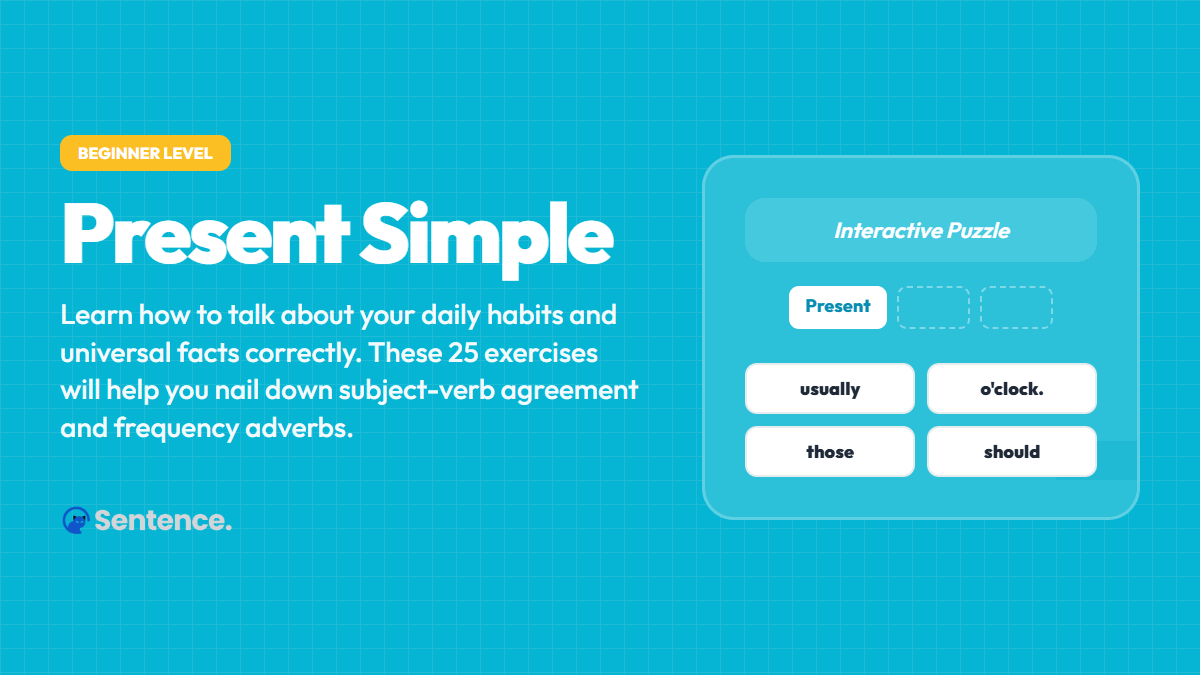
Master daily routines and facts with 25 interactive Present Simple exercises. Practice subject-verb agreement and frequency adverbs with instant feedback.

No comments yet. Be the first to share your thoughts!