Select the correct word:
Countable & Uncountable Explanation & Exercises

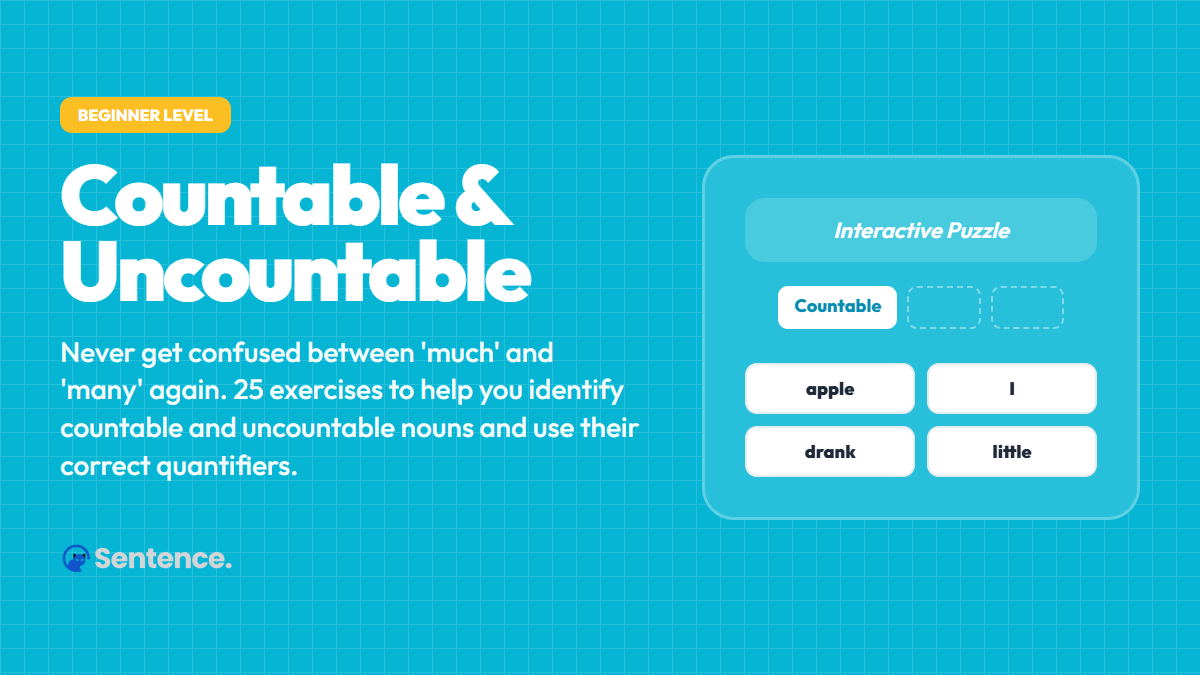
What are Countable and Uncountable Nouns?
Countable nouns are nouns you can count one by one, such as book, apple, and chair. They can be singular or plural, and they work directly with numbers.
Uncountable nouns are nouns we usually treat as mass or abstract ideas, such as water, rice, information, and advice. These nouns are not normally counted directly with numbers, so they often need quantity words or unit phrases.
This topic is important because noun type affects grammar choices across the sentence: articles, quantifiers, plural forms, and verb agreement. For example, we say many books but much information, and a piece of advice instead of an advice.
If you can quickly identify whether a noun is countable or uncountable, your sentence accuracy improves a lot. It becomes easier to choose the correct form in writing, speaking, and grammar exercises.
Structure (Form)
Countable nouns can be singular or plural. Uncountable nouns usually do not have regular plural form in normal meaning.
For uncountable nouns, use unit expressions like a cup of tea, a bottle of water, a piece of information.
| Noun Type | Can Be Counted Directly? | Plural Form? | Example |
|---|---|---|---|
| Countable | Yes | Yes | book/books, chair/chairs |
| Uncountable | No (directly) | Usually no | water, furniture, advice |
| Quantifier | Used With | Example |
|---|---|---|
| many / few | countable plural | many books, few students |
| much / little | uncountable | much time, little money |
| some / a lot of | both types | some rice, some apples |
| a piece of / a bottle of | uncountable measured units | a piece of news, a bottle of milk |
When to Use Countable and Uncountable Forms
Use noun type rules whenever you choose quantity words, article forms, and agreement patterns.
1) Quantity Statements
Use this pattern in Countable & Uncountable when the sentence goal fits Quantity Statements. Focus on the meaning first, then choose the correct form so the sentence sounds natural in real context.
- We have many chairs.
- We don't have much space.
- She has a lot of ideas.
2) Shopping and Food Context
Use this pattern in Countable & Uncountable when the sentence goal fits Shopping and Food Context. Focus on the meaning first, then choose the correct form so the sentence sounds natural in real context.
- I bought three oranges.
- I need some sugar.
- Please buy two bottles of water.
3) Academic and Work Writing
Use this pattern in Countable & Uncountable when the sentence goal fits Academic and Work Writing. Focus on the meaning first, then choose the correct form so the sentence sounds natural in real context.
- This report gives useful information.
- We collected several data points.
- They shared valuable feedback.
4) Unit Expressions for Uncountable Nouns
Use this pattern in Countable & Uncountable when the sentence goal fits Unit Expressions for Uncountable Nouns. Focus on the meaning first, then choose the correct form so the sentence sounds natural in real context.
- a piece of advice
- two cups of coffee
- three bags of rice
Examples
These examples show how noun type changes grammar choice.
Countable Nouns
- one chair / two chairs
- a pen / five pens
- many students in class
Countable nouns work directly with numbers.
Uncountable Nouns
- some milk
- a little money
- much homework
Use quantity words, not direct plural forms.
Quantifier Choice
- many books
- much information
- a lot of traffic
Choose quantifier by noun type.
Unit Expressions
- a piece of news
- two glasses of juice
- a bottle of oil
Units help quantify uncountable nouns.
Common Mistakes
These are frequent errors in everyday writing and tests.
1) Using Many with Uncountable Nouns
Wrong: many information
Correct: much information / a lot of information
Use much with uncountable nouns.
2) Making Uncountable Nouns Plural
Wrong: advices, furnitures
Correct: advice, furniture / pieces of advice
Many uncountable nouns do not take -s.
3) Wrong Article with Uncountable Nouns
Wrong: an equipment
Correct: equipment / a piece of equipment
Uncountable nouns usually do not use a/an directly.
4) Wrong Verb Agreement
Wrong: The furniture are new.
Correct: The furniture is new.
Uncountable nouns usually take singular verb.
Practice Exercises (Grammar Game Guide)
In this game, items test whether noun type is countable or uncountable, then check your article, quantifier, and verb choices.
Use this strategy: identify noun type first, choose matching quantity expression, then confirm agreement and natural form.
- Countable plural -> many/few + plural noun.
- Uncountable -> much/little + singular mass noun.
- Use unit phrases for measurable quantities.
- Check verb agreement after noun phrase.
This practice strengthens core grammar used across many other topics.
Learn the difference between many and much with 25 interactive Countable & Uncountable exercises. Master quantifiers today!

No comments yet. Be the first to share your thoughts!