Select the correct word:
Past Continuous Explanation & Exercises
What is Past Continuous?
Past Continuous describes actions that were in progress at a specific moment in the past. It is useful when you want to show background action, not just one completed event.
Example: I was studying at 9 p.m. This means the action was ongoing at that time. Past Continuous helps create richer timelines in stories and explanations.
This tense is often used together with Past Simple. Past Continuous gives the ongoing background, and Past Simple gives the interrupting action.
Past Continuous is valuable for timeline layering: it marks background activity while another event happens. This makes narratives clearer and easier to follow.
A useful contrast is with Past Simple: Past Continuous usually handles ongoing context, while Past Simple marks completed events or interruptions in that context.
Structure (Form)
Past Continuous uses was/were + verb-ing. Use was with I/he/she/it and were with you/we/they.
For negative, add not. For question, move was/were before subject. This pattern is stable and easy to practice once subject matching is clear.
| Type | Pattern | Example |
|---|---|---|
| Positive | Subject + was/were + V-ing | They were watching TV. |
| Negative | Subject + was/were + not + V-ing | She was not sleeping. |
| Question | Was/Were + subject + V-ing? | Were you studying? |
| Subject | Past Continuous Form |
|---|---|
| I / he / she / it | was + V-ing |
| you / we / they | were + V-ing |
When to Use Past Continuous
Use Past Continuous when you describe a past scene in progress, especially with time points, interruption events, or parallel actions.
1) Action in Progress at a Past Time
Use this pattern in Past Continuous when the sentence goal fits Action in Progress at a Past Time. Focus on the meaning first, then choose the correct form so the sentence sounds natural in real context.
- At 8 p.m., I was doing homework.
- They were practicing at noon.
- She was driving at that moment.
2) Background Action in a Story
Use this pattern in Past Continuous when the sentence goal fits Background Action in a Story. Focus on the meaning first, then choose the correct form so the sentence sounds natural in real context.
- It was raining while we were walking home.
- People were chatting before class started.
- The band was playing when we arrived.
3) Interrupted Action
Use this pattern in Past Continuous when the sentence goal fits Interrupted Action. Focus on the meaning first, then choose the correct form so the sentence sounds natural in real context.
- I was cooking when the phone rang.
- She was reading when the lights went out.
- They were sleeping when the alarm went off.
4) Two Actions Happening in Parallel
Use this pattern in Past Continuous when the sentence goal fits Two Actions Happening in Parallel. Focus on the meaning first, then choose the correct form so the sentence sounds natural in real context.
- While I was studying, my brother was gaming.
- We were discussing and they were taking notes.
- The kids were playing while their parents were talking.
Examples
These grouped examples help you compare core usage patterns.
Positive Form
- I was waiting for the bus.
- We were discussing the plan.
- He was preparing dinner.
Use this for ongoing action in past context.
Negative Form
- She was not listening.
- They were not paying attention.
- I wasn't using my phone.
Negative uses was/were + not + V-ing.
Question Form
- Were you sleeping at 10?
- Was he working yesterday evening?
- Were they waiting for us?
Start question with was/were.
With Past Simple
- I was walking when it started to rain.
- She was typing when the call came in.
- They were eating when I arrived.
Common pattern: ongoing action + interruption event.
Common Mistakes
These errors are common in grammar exercises and storytelling.
1) Missing -ing Form
Wrong: I was study.
Correct: I was studying.
Past Continuous always needs verb-ing.
2) Wrong Was/Were Choice
Wrong: They was playing.
Correct: They were playing.
Match subject carefully.
3) Using Past Continuous for Short Completed Event
Wrong: I was reached home at 9.
Correct: I reached home at 9.
Use Past Simple for short completed events.
4) Reversed Interruption Logic
Wrong: I cooked when the phone was ringing.
Correct: I was cooking when the phone rang.
Background action = past continuous, interrupting event = past simple.
Practice Exercises (Grammar Game Guide)
In this grammar game, you choose correct past continuous forms and combine them with timeline clues like when and while.
Use this strategy: decide if action was ongoing, choose was/were by subject, apply -ing form, then check whether another action interrupts it.
- Check if sentence needs background action.
- Match subject with was or were.
- Use verb-ing spelling correctly.
- Separate ongoing action from short interrupting action.
This practice improves storytelling clarity and past timeline accuracy.
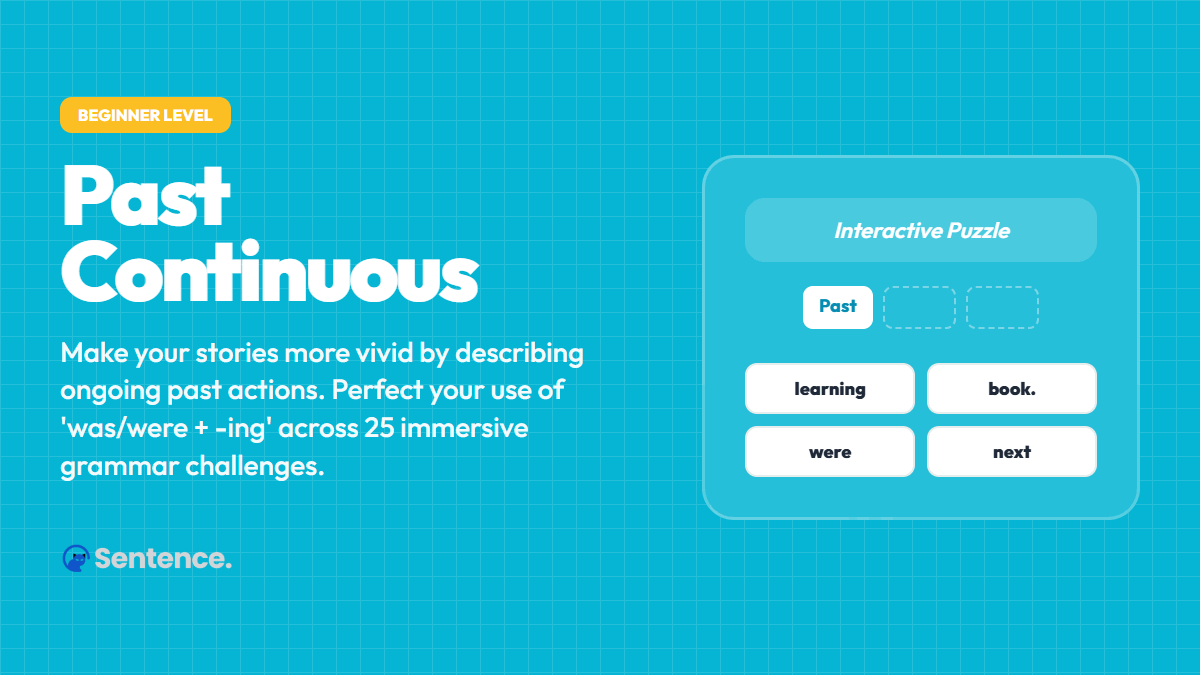
Bring your stories to life with 25 interactive Past Continuous exercises. Master was/were + -ing and describe the past vividly!

No comments yet. Be the first to share your thoughts!