
Master New Words Like a Native! 🧠
Stop translating in your head. The Vocabulary Lab maps words directly to images and sound, so new words feel natural from the moment you learn them — not borrowed from your native language.
The "No-Translation" Secret
Translation creates a bottleneck. Every time you want to use a word, your brain first retrieves its native-language equivalent and then converts it — a chain that makes real-time speech and writing slow and effortful. The Vocabulary Lab is designed to bypass that chain entirely.
Instead of showing a word next to its translation, each flashcard pairs the English word with a high-resolution image and a native audio clip. Your brain forms the connection directly: sound and image together, with no middleman language involved.
Over repeated exposure, the word starts to feel immediate — you see the image, the English word surfaces. That is the "no-translation" state that native-level fluency requires, and it is what the Lab trains from the very first card.
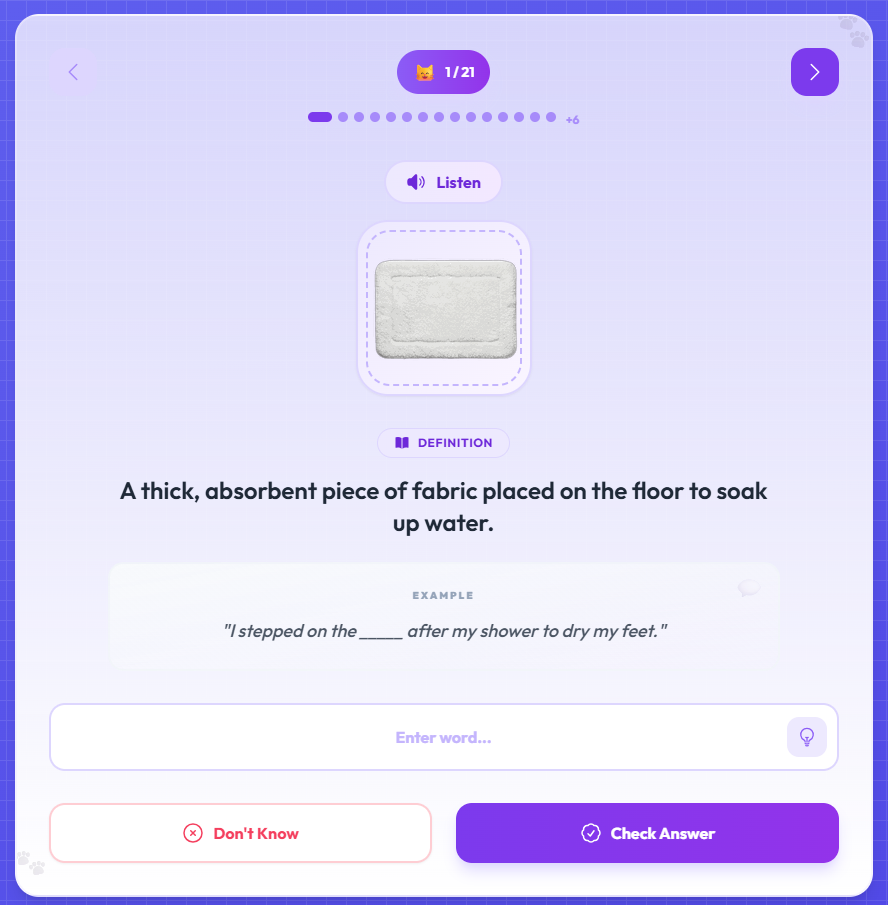
Active Challenge Mode
The first time you see a flashcard, you are in observation mode. You look at the image, hear the pronunciation, and read an example sentence showing the word used in natural context. This is your first exposure — the goal is to absorb, not memorize.
The card then flips to Challenge Mode. The word is hidden, the audio plays, and you must type it from memory. No multiple choice options, no word bank — you produce the spelling yourself. This active recall step is what research consistently identifies as the most effective way to move vocabulary from short-term recognition into long-term usable memory.
If you type the word correctly, the card is marked complete. If you make a mistake, the correct spelling is shown, the audio replays, and the card returns to rotation. Every word in a unit must be answered correctly before the unit counts as finished — there is no skipping past a word you have not learned yet.

17 Curated Thematic Sets
The Lab is organized into seventeen themed vocabulary units, each one focused on a specific context where you are likely to use English. Rather than random word lists, every unit is built around a domain that matters: daily life, work, travel, academic settings, emotional communication, and more.
This thematic structure matters because vocabulary learned in context sticks better than isolated word lists. When you learn the word "invoice" inside a Business Communication unit alongside "quotation," "overdue," and "remittance," the words reinforce each other and the context gives each one meaning.
Complete one unit fully before moving to the next. The words within a unit are selected to work together, and partial knowledge of many topics is far weaker than solid knowledge of fewer.
- Daily Essentials
- Business Communication
- Travel & Hospitality
- Academic Word List
- Emotional Intelligence
Built-in Spaced Repetition
Getting a word right once does not mean it is permanently learned. Memory fades, and the timing of review matters enormously. The Lab tracks which words you found difficult and schedules them to reappear at the right intervals — often enough to prevent forgetting, but not so often that it wastes your time on words you already know.
This is spaced repetition: a technique with decades of research behind it, showing that reviewing material at increasing intervals produces far stronger long-term retention than repeating the same words every day.
The result is that your weak words get more attention automatically. You do not have to decide which words to review — the Lab manages that for you, so every session is optimized for the words you actually need to work on.