
Master the Sound of English! 🎧
Stop guessing what people are saying. The Listening Lab trains you to map sounds to meaning with precision, using real native speech across two formats that target different aspects of listening skill.
Two Ways to Listen
Listening skill is not one thing — it is at least two: the ability to hear sounds accurately at the word level, and the ability to follow meaning across longer stretches of speech. Most learners are weak in both but for different reasons, so training them separately is more effective.
Dictation builds precision at the word and syllable level — the ability to catch exactly what was said, including the small connecting words and endings that learners routinely miss. Comprehension builds fluency at the discourse level — the ability to follow a story, track characters, and understand implications without processing every individual word consciously.
Catsentence offers both formats across 20+ units. Use dictation when you want to close the gap between what you hear and what is actually being said. Use comprehension when you want to train real-world listening stamina.
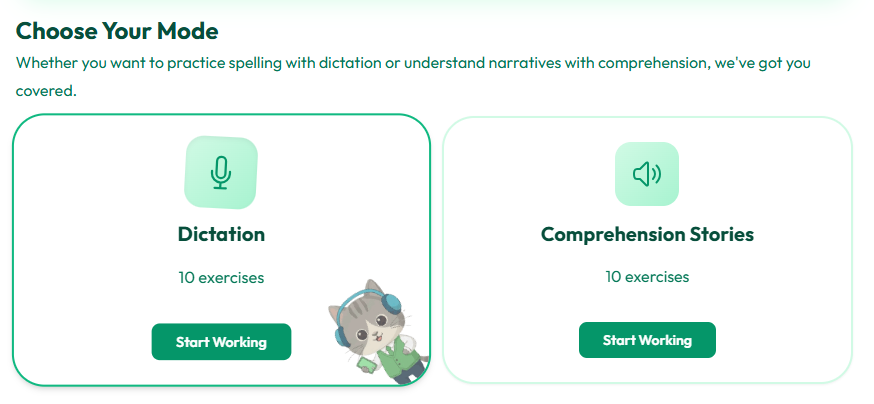
The Dictation Lab
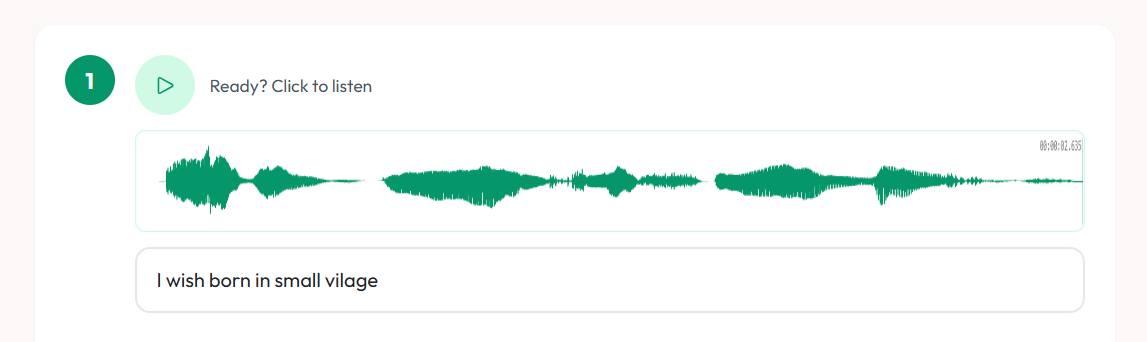
In the Dictation Lab, each exercise gives you five audio clips per page, each one a full sentence spoken at natural pace by a native speaker. You play a clip using the waveform player — the audio is visualized as a sound wave you can see moving as it plays — and then you type exactly what you heard into the text field below it.
There is no speed reduction, no unnatural pausing. The goal is to train your ears on real speech, because slowed-down audio creates a different listening skill than real-world speech requires. You can replay each clip as many times as you need, but try to reduce your replay count over time as your ear improves.
When you hit "How Did I Do?", your answers are scored using a text similarity algorithm rather than a strict exact match. Minor spelling errors do not destroy your score, but genuinely misheard words show up clearly in your accuracy rating. After scoring, the correct sentence appears beside your answer so you can compare them word by word.
Comprehension Stories
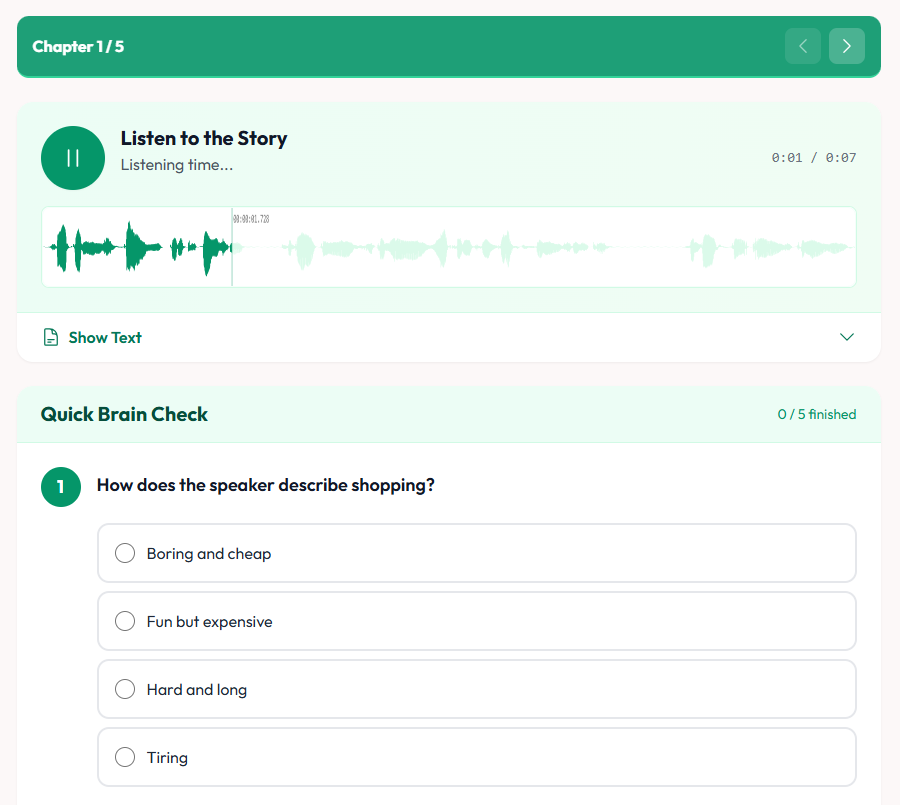
The Comprehension format uses full audio stories divided into chapters. Each chapter is a natural, continuous piece of spoken English — not a scripted drill, but a real narrative with characters, events, and progression.
After listening to a chapter, you answer multiple-choice questions about what happened. Questions test whether you understood the meaning of the chapter — who did what, why, what it implied — not just whether you caught individual words. You can replay the chapter audio as many times as you need before answering.
A transcript toggle is available once you have made your first attempt at the questions. Use it to check specific moments in the audio you were unsure about, then replay the section to connect the written words to what you heard. This combination of listening, answering, and reading the transcript builds the kind of deep comprehension that carries over into real conversations.
- Intensive Dictation Drills
- Extensive Story Comprehension
- Live Waveform Feedback
- Similarity-based Accuracy Scoring
Pro Tip: Slow it Down! 🐢
If a sentence is moving too fast, use the playback speed control to slow the audio to 0.75x while you are building your ear. This is especially useful in the first few sessions with a new type of speaker accent or a particularly fast delivery.
The key is to use the slower speed as a temporary scaffold, not a permanent crutch. Once you can catch the words at 0.75x, move back to 1.0x for your next attempt. Your goal is always to work at natural speed — that is the speed English actually happens at.
For comprehension exercises, try your first listen at full speed without stopping. Accept that you may miss some details. This trains your brain to extract meaning from partial information, which is exactly what you need to do in real conversations where you cannot ask the speaker to slow down.