Much vs. Many vs. A Lot Of: What's the Difference?
How much? How many? When should you say 'much money' and when 'a lot of money'? This guide breaks down the rules for countable and uncountable nouns with clear examples and a simple test.
How much? How many? When should you say 'much money' and when 'a lot of money'? This guide breaks down the rules for countable and uncountable nouns with clear examples and a simple test.
Imagine you are at a grocery store. Do you ask for "how much apples" or "how many apples"? If you have "many water" at home, should you buy more? These small words — much, many, and a lot of — cause confusion for learners at every level because the choice depends on whether the noun is countable or uncountable.
The good news is that the rules are very clear once you understand one simple idea: can you count it or not? Many is for things you can count one by one. Much is for things you measure as a whole. And a lot of works for both. This guide will walk you through each word, show you when to use what, and help you avoid the most common mistakes.
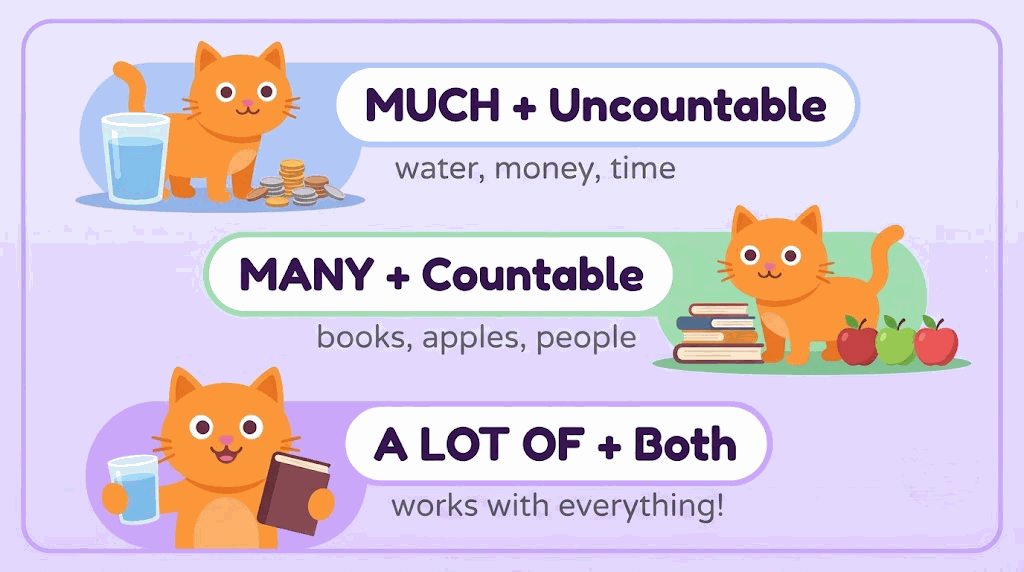
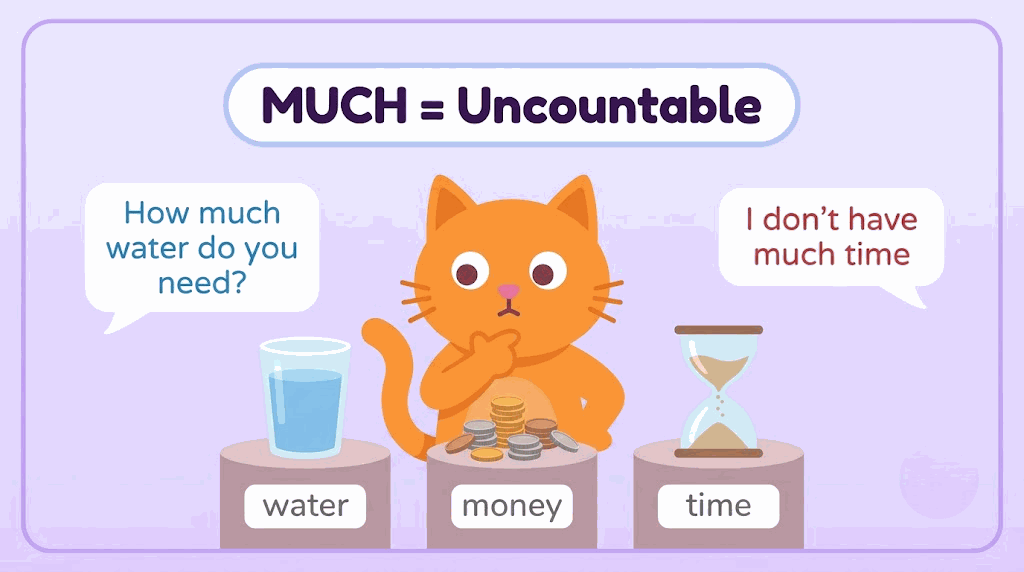
Use much with uncountable nouns — things that cannot be counted individually. These are usually substances, liquids, concepts, or abstract ideas. You don't say "one water, two waters" — you say "some water" or "a lot of water."
Much is typically used in questions and negatives:
Use many with countable nouns — things that have a plural form and can be counted with numbers. One apple, two apples, three apples. Many apples.
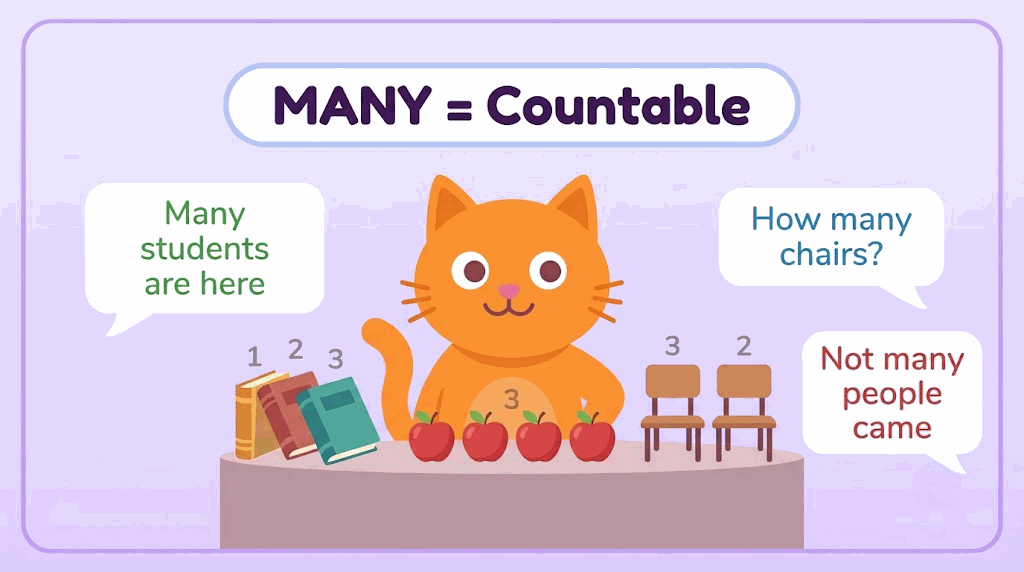
Many works in all sentence types:
If you can put a number in front of it (one book, three cars), use many. If you can't (one water ✗, two advice ✗), use much or a lot of.
These common combinations follow the same countable/uncountable rules:
Too much + uncountable
"I drank too much coffee."
So much + uncountable
"Thanks so much for your help!"
Too many + countable
"I have too many emails to answer."
So many + countable
"There were so many people at the concert."
A lot of (and its more casual cousin lots of) is the most flexible option. It works with both countable and uncountable nouns, and it sounds natural in affirmative sentences where "much" would feel stiff.
A lot of works everywhere:
"Lots of" is less formal but very common in spoken English.
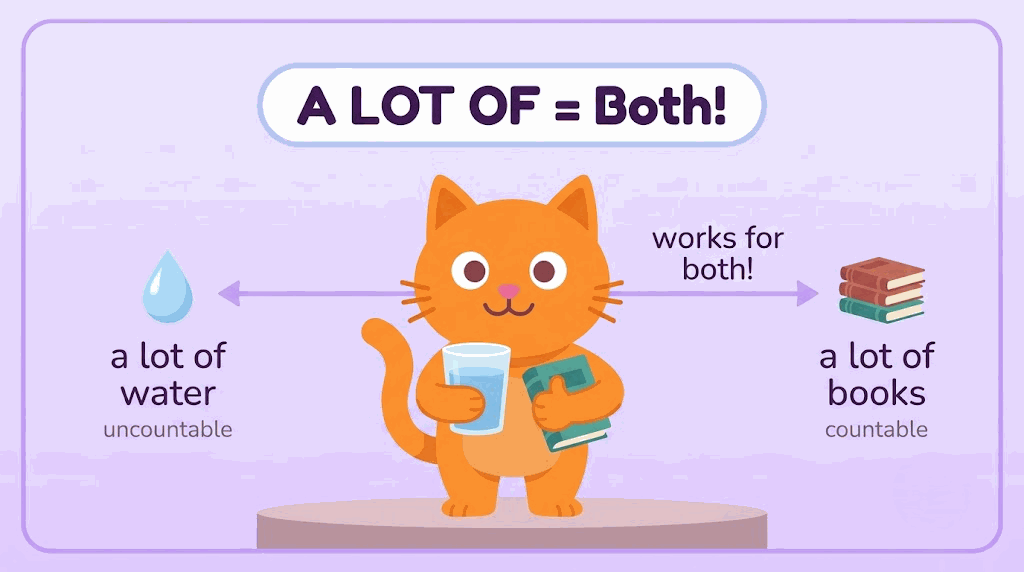
In academic or professional writing, many and much are preferred over "a lot of." In everyday conversation, "a lot of" is the most natural choice for affirmatives. Choose based on your context.
When a lot is used without "of," it becomes an adverb modifying a verb — not a quantifier for a noun. This is a common point of confusion:
Here is a quick reference for all three words at a glance:
| Word | Countable? | Uncountable? | Best In |
|---|---|---|---|
| Much | ✗ | ✓ | Questions & Negatives |
| Many | ✓ | ✗ | All sentence types |
| A Lot Of | ✓ | ✓ | Affirmatives (conversational) |
The most common place you'll use these words is in questions with how. The rule is simple: "How much" for uncountable, "How many" for countable.
At a grocery store:
A: "How much rice do we need for dinner?"
B: "Not much. Just one cup."
A: "And how many eggs should I buy?"
B: "Get a lot of eggs — we're baking a cake too."
Both words can stand alone when the noun is already understood from context. This is called the pronoun use:
❌ "He has much money."
✅ "He has a lot of money."
"Much" in affirmatives sounds very formal. Use "a lot of" instead.
❌ "I don't have many furniture."
✅ "I don't have much furniture."
✅ "I don't have many chairs." (chairs = countable)
❌ "How much clothes should I pack?"
✅ "How many clothes should I pack?"
Some nouns like "clothes," "goods," and "thanks" are always plural in form, so they use "many" even though they might feel uncountable.
❌ "I like a lot of this book." (wrong — this means you like a large number of books)
✅ "I like this book a lot." (adverb = very much)
"A lot of" must be followed by a noun. "A lot" alone modifies the verb. Compare: "I read a lot of books" (many books) vs. "I read a lot" (I read frequently).
Choose the correct option for each sentence:
How ___ sugar do you take in your coffee?
There aren't ___ parks in this neighborhood.
She has ___ experience in marketing.
How ___ students are in your class?
I don't have ___ homework tonight.
Answers:
1. much (sugar = uncountable) / 2. many (parks = countable) / 3. a lot of (experience = uncountable, affirmative) / 4. many (students = countable) / 5. much (homework = uncountable, negative)
The difference between much, many, and a lot of comes down to one question: can you count it? Use many for countable nouns, much for uncountable nouns (mostly in questions and negatives), and a lot of when you need a safe option that works everywhere.
Here is a quick mental checklist for your daily conversations:
The next time you're at a store or planning an event, pay attention to these words. With consistent practice, choosing between much, many, and a lot of will become second nature.