Guide to Imperative Sentences
Learn how to give clear commands, polite requests, and precise instructions without sounding rude. This guide breaks down the simple 'boss' mood of English.
Learn how to give clear commands, polite requests, and precise instructions without sounding rude. This guide breaks down the simple 'boss' mood of English.
English is a language of conversation, but it is also a language of action! Whether you are telling a friend to "Sit down," a chef to "Add salt," or a student to "Open your book," you are using one of the most powerful and direct tools in grammar: the imperative sentence.
Think of the imperative mood as the "boss" of English. It cuts out the fluff and gets straight to the point.

The first thing you'll notice about an imperative sentence is that something is missing: the subject. In almost every other English sentence, you need to say who is doing the action. But in an imperative, we already know who we're talking to—You!
In the world of grammar, we call this ellipsis (or just "ghosting" the subject). Since the person we are talking to is right there in front of us, saying "You" is just extra work. It's as if the word is floating in the air between you and your listener—everyone knows it's there, but nobody needs to say it.
You Close the door.
You Listen carefully.
You Don't touch that.
Even though we usually hide the "You," we can bring it back if we need to be really specific. Grammar pros call this the Emphatic Imperative. If you are pointing at one person in a noisy crowd, you might say, "You, come here!" or if you're making a deal with a friend, "I will cook, and you wash the dishes!" In these cases, re-adding the subject adds extra impact or clears up confusion.
By starting your sentence directly with the base verb (like "Run," "Eat," or "Stay"), you give your message a lot of punch. This is what separates "telling someone what to do" from "stating a fact." Compare "You close the door" (just a boring fact) with "Close the door" (a request for action). That missing subject is the secret signal that tells the listener: "Hey, I need you to do something!"
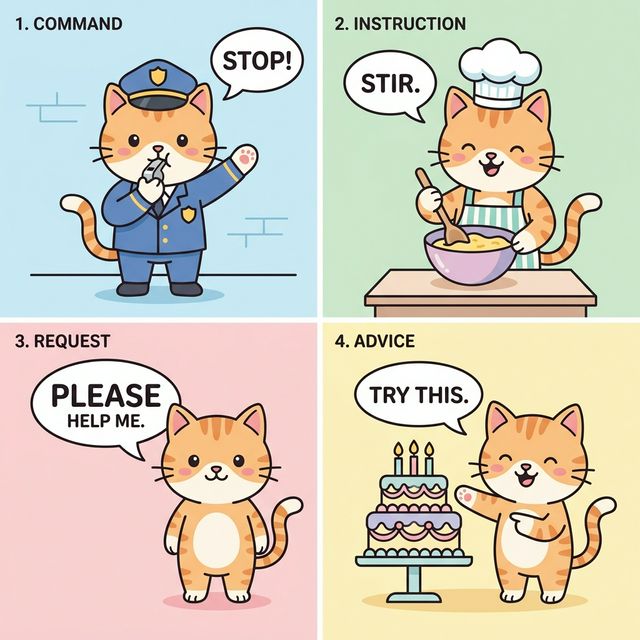
Don't be fooled—imperative sentences aren't always "bossy" commands. Depending on your tone and the situation, they can do four very different jobs. Mastering these is the key to sounding natural and friendly in English.
| Job | What it does | Example |
|---|---|---|
| Command | Giving a direct order. | "Stop the car!" |
| Instruction | Giving step-by-step help. | "Stir for five minutes." |
| Request | Asking nicely. | "Help me with this, please." |
| Advice | Friendly suggestions. | "Try the chocolate cake." |
It's a bit like a volume knob on a radio. Setting it to "10" is a serious command; setting it to "2" is just a friendly suggestion. The verb doesn't change, but your vibe does!
Being able to adjust this 'volume' is what makes your English sound natural and empathetic.
Because imperative sentences are so direct, they can sometimes sound a little rude if you aren't careful. In English, we use "softening" words to turn a sharp command into a warm, polite request. This is a must-learn skill for staying on everyone's good side.
Pop a "please" at the start or end of your sentence. It instantly makes you sound more helpful and less demanding.
When you want to do the action together, use "Let's" (Let us). This makes you sound like a team player instead of a boss.
Adding "just" acts like a tiny cushion. It suggests that the task is small, quick, and no big deal for the other person.
The best strategy depends on who you are talking to. If you're hanging out with friends, a quick "Just pass me that" is perfect. But in an office, it's usually safer to stick with "Please" or even turn it into a question like "Could you...?" to keep things professional and polite.
What if you want someone not to do something? Easy! We use the word "Don't" (Do not). No matter who you're talking to, "Don't" is the go-to word for stopping an action.

It's like a "No Entry" sign for grammar. The formula is simple and never changes, no matter who you're talking to: Don't + [Base Verb].
In English, "Don't" is the universal stopper—short, sharp, and instantly understood.
In a rush or a dangerous situation, "Don't" is your best friend. It's short and gets the message across instantly.
Imperatives are pretty simple, but there are two common traps that can make your English sound a little "off" to native speakers.
You can't use "-ing" verbs or past tense here. Stick to the basic dictionary form of the verb.
Adding "You" back in usually makes you sound angry or like you're yelling. Save it for when you're actually frustrated!
In many languages, commands start with 'To'. In English, we drop the 'To' entirely. Don't let it sneak in!
The imperative sentence is your secret weapon for clear communication. From giving directions to leading a team or just being a good neighbor, knowing how to "boss" your English correctly will make you sound much more confident. Listen for these sentences today—you'll hear them everywhere!