Difference Between This vs. Those
Confusion between 'this' and 'those' is common for English learners. This guide clarifies the differences in quantity and distance, helping you use demonstratives with confidence.
Confusion between 'this' and 'those' is common for English learners. This guide clarifies the differences in quantity and distance, helping you use demonstratives with confidence.
In English, we use special words called demonstratives to point to things. The most common ones are this, that, these, and those. While they seem simple, choosing between this and those can be tricky because it involves two different rules: how many things you are pointing to, and how far away they are.
In this guide, we will break down exactly when to use each word, focusing on the contrast between this (singular and near) and those (plural and far). By the end, you'll be able to point to anything in English with perfect accuracy.
Demonstratives tell the listener two things: quantity (is it one or more than one?) and position (is it close to me or far away?). To choose the right word, you just need to answer two simple questions.
| Demonstrative | Quantity | Distance | Example |
|---|---|---|---|
| This | Singular (1) | Near | This apple in my hand. |
| That | Singular (1) | Far | That bird in the tree. |
| These | Plural (2+) | Near | These books on my desk. |
| Those | Plural (2+) | Far | Those stars in the sky. |
As you can see, this and those are different in both ways. This is for one thing close to you, while those is for multiple things far away.
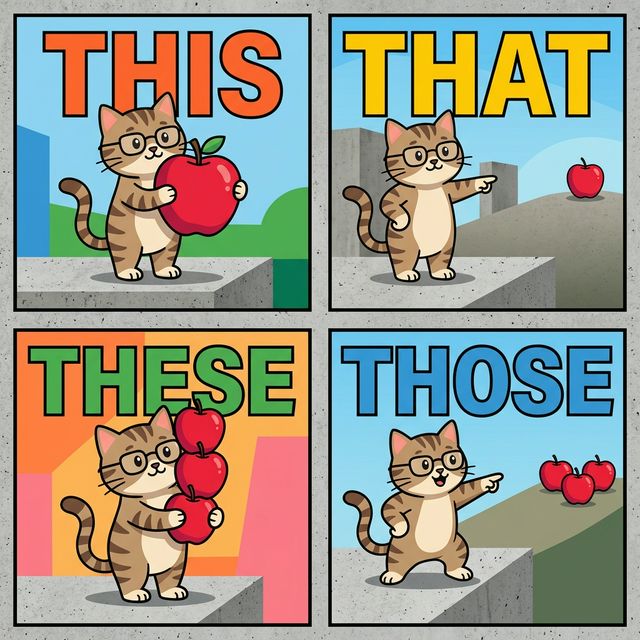
We use this for a single object, person, or idea that is physically close to us or very recent in time. It represents the "here and now." When you use "this," it often implies that the object is within your personal space—something you could reach out and touch or something that is currently the main focus of your conversation.
The use of this isn't just about physical distance; it's also about emotional or temporal closeness. For example, if you are introducing a friend standing next to you, or talking about a problem you are currently facing, "this" is the correct choice.
In writing, "this" is also used to refer back to the exact sentence or idea you just mentioned. For example: "The team worked late to finish the project. This effort led to their success." Here, "this" points directly to the effort mentioned in the previous sentence.
While "this" is for the near and singular, those is for the far and plural. We use it for multiple objects or people that are physically far away, or for events that happened in the distant past. It creates a sense of "there and then," putting distance between the speaker and the subjects.
This demonstrative is essential for pointing out groups of things that are out of reach, such as birds in the sky or cars in a distant parking lot.
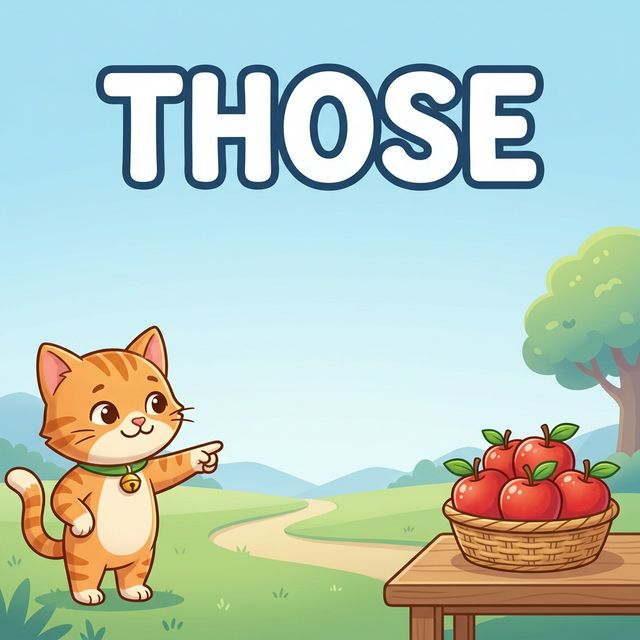
If you have to point your finger across a room, a street, or even a long period of time, and there are multiple things you are pointing at, those is your best friend. It helps the listener look away from you and toward the subject.
A common mistake is using "those" for things that are close by. Remember, if you are holding three books, you say "these books." If the books are on a shelf across the room, only then do you say "those books." It's all about the gap between you and the objects.
Let's compare this and those directly to see how the meaning changes. When you switch between these two, you aren't just changing the amount of things; you are also repositioning yourself in the world of the conversation. Imagine you are standing in a large public park.
"I like this flower." (You are pointing to one flower right at your feet. It's unique and touchable.)
"I like those flowers." (You are pointing to a group of flowers on the other side of a lake. They are distant and numerous.)
Notice how Scenario A feels intimate and focused on one specific item close to you, while Scenario B feels observant of a group at a distance. Here is a quick mental checklist to help you choose between them:
| Question | Answer for "This" | Answer for "Those" |
|---|---|---|
| How many? | Just One (Singular) | Two or more (Plural) |
| Where is it? | Right here (Near) | Over there (Far) |
| Can I touch it? | Yes, usually | No, you must point |
| Verb to use? | Is (This is...) | Are (Those are...) |
Think of it like a camera lens. This is a macro shot focusing on something close and detailed. Those is a wide-angle shot looking at a group of things in the landscape. By understanding this mental shift, you'll stop hesitating and start speaking with true native-like confidence.
Many learners get confused when the noun doesn't end in 's' but is still plural, or when talking about abstract ideas.
Understanding the difference between this and those is a key step in expressing distance and quantity clearly. By becoming comfortable with these demonstratives, you gain more precision in your daily English conversations. Keep practicing, and observe how often these small words help you point out and describe the world around you.