Difference Between Either vs. Neither
Understand the rules of 'either' and 'neither' in English. This guide covers choice, rejection, countability, and formal agreement rules with 2D illustrations.
Understand the rules of 'either' and 'neither' in English. This guide covers choice, rejection, countability, and formal agreement rules with 2D illustrations.
English grammar offers specific tools for different logical scenarios. When faced with two possibilities, you need either to invite a choice or neither to reject them both. While they seem straightforward, their logic is fundamentally opposite, and learning them is key to sounding like a native speaker.
This guide breaks down the structural differences, countability rules, and formal agreement traps associated with these two important terms. By the end, you will know exactly when to reach for "either" and when "neither" is the better choice.
Either is used when you are talking about a choice between two people or things. It essentially means "one or the other." It is a positive term because it acknowledges the availability of a selection. In most cases, it implies that the outcome will be inclusive of one of the options.
Either way: Both ways are acceptable.
Either of: Used with plural nouns. "Either of the options is valid."
Either... or: The standard conjunction for choice. "You can have either coffee or tea."
"Would you like to sit inside or outside?" "Either is fine with me."

Neither is the negative counterpart to either. It means "not one and not the other," effectively rejecting both possibilities in a pair. It is a more efficient way of saying "Not A and Not B." It creates a sense of exclusion and is often used to clarify that zero options from the pair are suitable or true.

Neither side: Both teams/groups are excluded.
Neither of: "Neither of the books belongs to the library."
Neither... nor: "Neither the rain nor the snow stopped the race."
"Since I was tired, I chose neither path and went home."

The main difference lies in the logical outcome: Either is (OR), while neither is (NOR). In formal English, both words are typically treated as singular subjects when they stand alone or when followed by the preposition "of."
When you use either... or or neither... nor to join two subjects that are different (one singular and one plural), the verb should agree with the subject closest to it.
| Rule | "Either" | "Neither" |
|---|---|---|
| Grammatical Role | Inclusive Choice (Pick one) | Exclusive Rejection (None) |
| Matches with Or | Matches with Nor | |
| Verb Agreement | Singular (Either is...) | Singular (Neither is...) |
| Negation Context | Used with "not" (don't... either) | Negative by itself (Neither was...) |
By using these terms with their correct formal partners, you signal a clear understanding of the logical relationship between the objects you are discussing. It moves your English from simply being "understood" to being "correct."
To use these correctly, you must avoid several key linguistic traps. These are high-frequency errors that can make your English sound cluttered or structurally weak. Let's explore the most common ones and how to fix them for good.
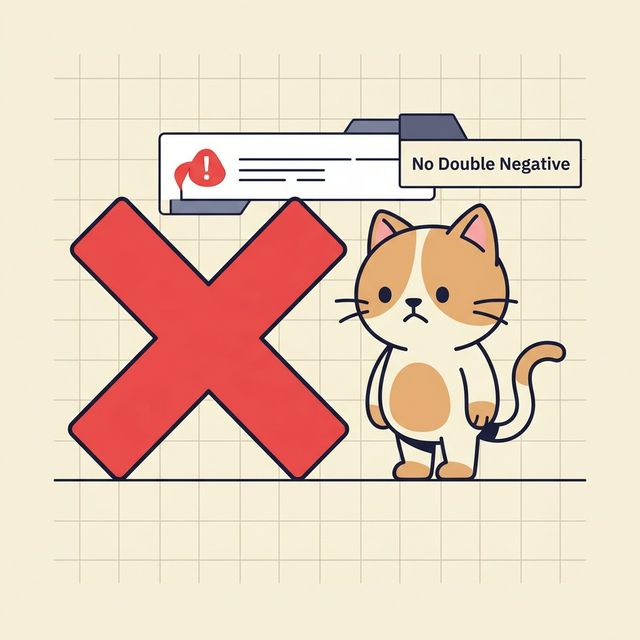
Because "neither" already carries a negative charge, using another negative word (like not or don't) is repetitive and creates a double negative.
❌ I don't need neither of them.
✅ I need neither of them.
✅ I don't need either of them.
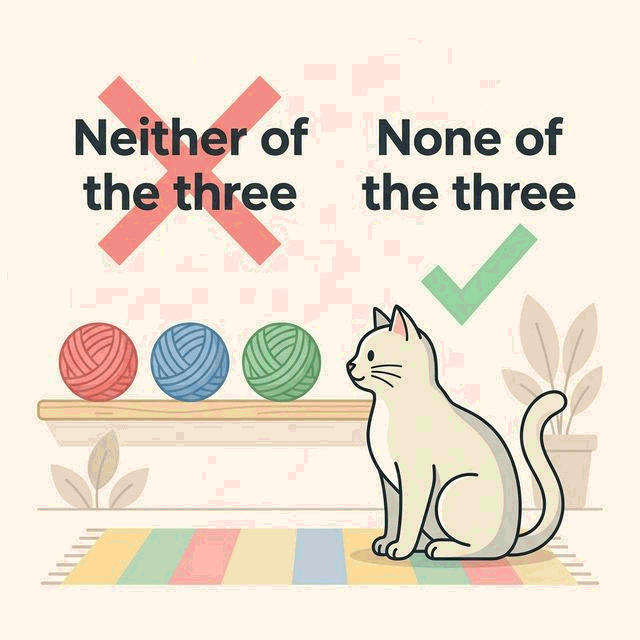
Both terms are strictly limited to pairs. When referring to three or more people or objects, you must switch to different words like "none" or "any."
❌ Neither of the three paths is safe.
✅ None of the three paths is safe.
✅ Any of these paths will work.
When using "either... or," you should try to keep the words that follow them in the same grammatical form (this is called parallelism). It makes your sentences symmetrical and easier to read.
Asymmetrical
"You can either eat here or to go."
Parallel
"You can either eat here or go."
Using either and neither correctly is about more than just matching definitions—it's about logical precision. By understanding the countability rules (pairs only) and the subject-verb agreement (singular), you can communicate choices and rejections with the confidence of a native speaker. Keep practicing these in your daily writing to sharpen your English proficiency.