May vs. Might: Possibility and Permission
Should you say 'I may go' or 'I might go'? Both talk about possibility, but the level of certainty is different. This guide breaks down probability, permission, past forms, and the most common mistakes.
Should you say 'I may go' or 'I might go'? Both talk about possibility, but the level of certainty is different. This guide breaks down probability, permission, past forms, and the most common mistakes.
Modal verbs are the most flexible tools in English, and may and might are two of the trickiest. They can express possibility, permission, and even polite requests — sometimes interchangeably, sometimes not. A learner might hear "I may come" and "I might come" and wonder: what's the actual difference?
The short answer is probability. May suggests something is more likely to happen. Might suggests a lower chance — it's more uncertain. But that's only part of the story. May is also the formal word for asking permission, while might is the only choice for past possibility. This guide will walk you through every use so you can choose the right word with confidence.
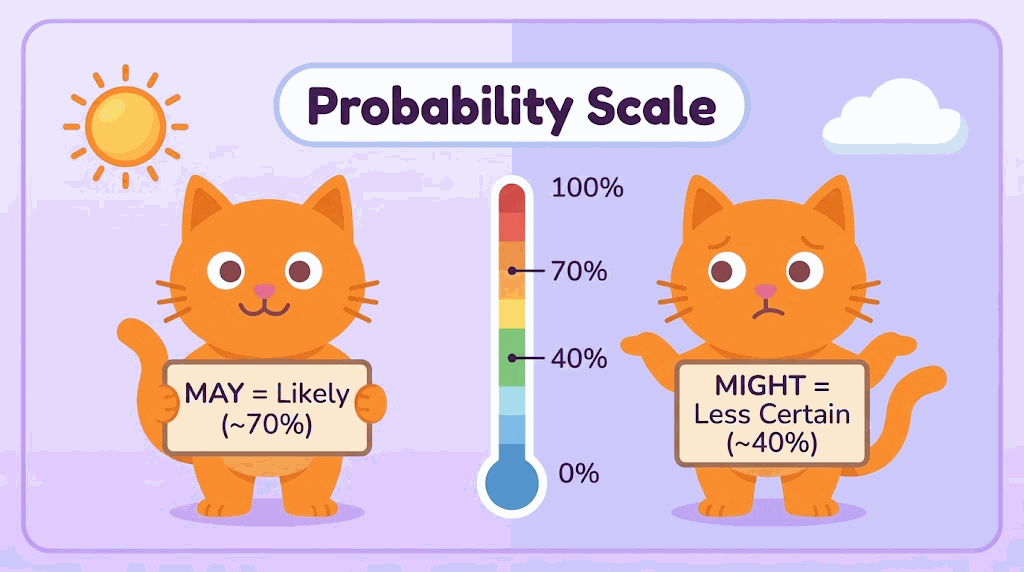
Both may and might express possibility, but they sit at different points on the probability scale. Think of it as a thermometer: may is warm (likely), might is cool (possible but uncertain).
May suggests a real possibility — it could easily happen:
(I'm leaning toward going.)
(The forecast shows clouds.)
Might suggests a weaker possibility — it's uncertain:
(I'm not sure yet. Maybe, maybe not.)
(It's possible, but I wouldn't bet on it.)
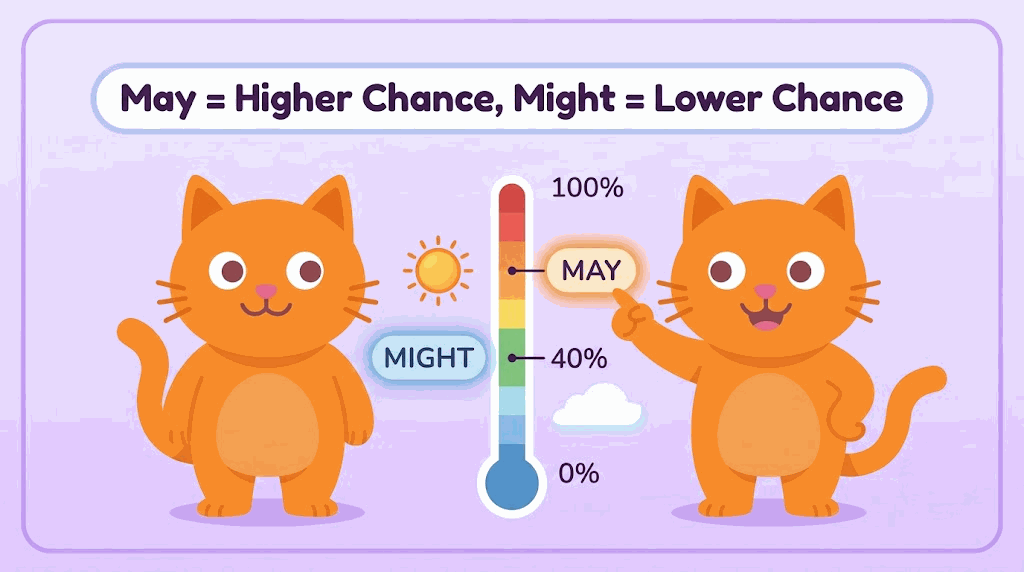
In everyday conversation, many native speakers use might for everything, even when the chance is high. The strict probability difference is more visible in writing. If you're unsure, might is the safer choice for spoken English.
One of the most important uses of may is asking and giving permission. This is the formal, polite version of "can." You'll hear it in classrooms, restaurants, and professional settings.
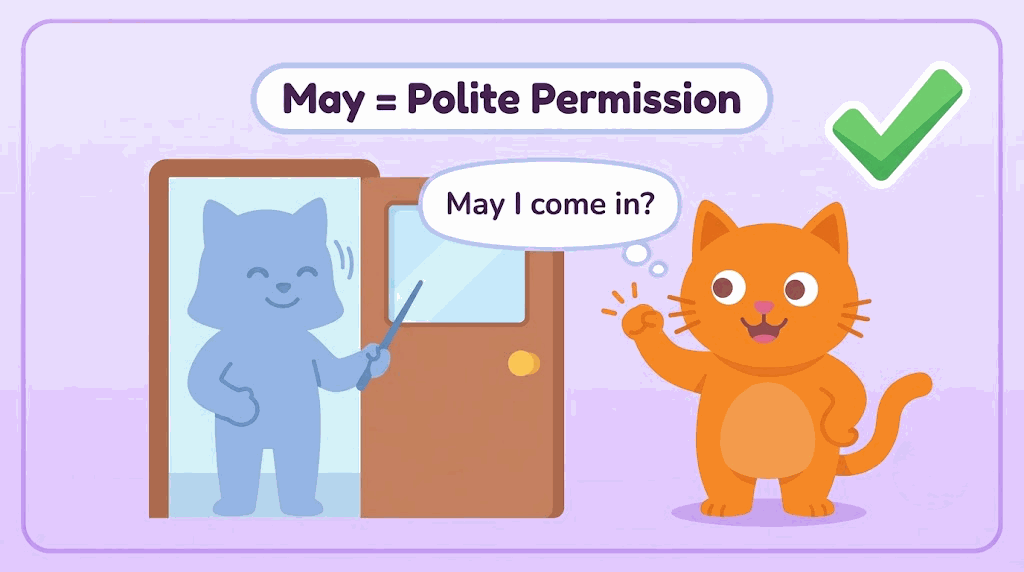
Common permission examples:
Might is the only choice when talking about past possibility. May have is also grammatically possible, but might have is far more common in both speech and writing. This structure uses might + have + past participle.
(I don't know for sure, but that's my guess.)
(It's a possible explanation.)
(Hypothetical past — third conditional.)
Understanding past possibility is crucial, but you also need to know how to express lack of possibility or refusal of permission. That is where the negative forms come in. Let's look at how may not and might not differ in meaning and tone.
The negative forms follow the same pattern as other modals. The meaning of may not vs might not can be quite different depending on the context. The key difference is that "may not" often carries a stronger sense of refusal or higher certainty that something won't happen, while "might not" leaves more room for doubt.
Think about it this way: if a teacher says "You may not leave," that is a firm rule — you are not permitted. But if a friend says "I might not come to the party," there is still a chance they will show up. The first is a closed door; the second is a door that is still slightly open.
Mayn't is extremely rare and almost never used in modern English. Always write out "may not."
Mightn't is sometimes used in British English but is uncommon in American English. Stick with "might not" to be safe.
Now that you have seen each use individually — possibility, permission, past forms, and negatives — it helps to see everything side by side. The table below summarizes all the key differences between may and might across every context. Use it as a quick reference whenever you are unsure which word to choose.
Notice how may consistently appears in contexts with higher certainty or formality, while might leans toward lower certainty, past situations, and everyday speech. This pattern repeats across all four rows of the table.
| Use | May | Might |
|---|---|---|
| Possibility (present) | Higher chance (~70%) "It may rain." |
Lower chance (~40%) "It might rain." |
| Permission | Formal, common "May I come in?" |
Rare, old-fashioned "Might I suggest..." |
| Past possibility | Possible but less common "He may have left." |
Standard choice "He might have left." |
| Negative (possibility) | "May not" = possible it isn't "It may not work." |
"Might not" = less certain "It might not work." |
Looking at the table, one pattern stands out: may is the confident, formal choice, while might is the cautious, flexible option. When you want to sound polite and proper, reach for "may." When you want to express uncertainty without committing too strongly, "might" is your word. For past events, always lean toward "might have" — it is the most natural choice in both speech and writing.
❌ "She may went to the store."
✅ "She might have gone to the store."
Past possibility uses might have + past participle. "May have" is also possible, but "might have" is more natural.
❌ "I may to go to the party."
✅ "I may go to the party."
Like all modals, may and might are followed by the base form of the verb — no "to."
❌ "Might I use your phone?" (too formal — sounds strange)
✅ "May I use your phone?" (natural formal request)
✅ "Can I use your phone?" (natural casual request)
Choose the best option for each sentence:
I'm not sure yet, but I ___ join the trip. (less certain)
___ I open the window? It's stuffy in here.
She looks tired. She ___ worked all night.
The forecast says it ___ rain tomorrow, so bring an umbrella. (likely)
You ___ leave the room until the test is over. (not allowed)
Answers:
1. might (less certain) / 2. May (polite permission) / 3. might have (past possibility) / 4. may (likely, based on forecast) / 5. may not (prohibition)
The choice between may and might depends on three things: probability (how likely?), politeness (asking permission?), and time (present or past?). Use may for higher probability and formal permission. Use might for lower probability and past possibility with "might have."
Here is a simple way to test yourself in real conversations. The next time you are about to say "I may" or "I might," pause and ask: Am I guessing about the past? Use "might have." Am I asking for something politely? Use "May I." Am I talking about how likely something is? The less sure I am, the better "might" fits.
To see this in action, imagine you are planning a weekend trip with a friend. You check the weather: "It may rain on Saturday" (the forecast shows a good chance). Your friend asks about tickets: "We might not find seats if we wait too long" (uncertain, but possible). You ask a shop keeper: "May I return this if it doesn't fit?" (polite permission). Later, you find out the show was sold out: "We might have missed our chance" (past possibility). In a single conversation, you have used all four forms naturally. With regular practice, choosing between may and might will become just as instinctive.