
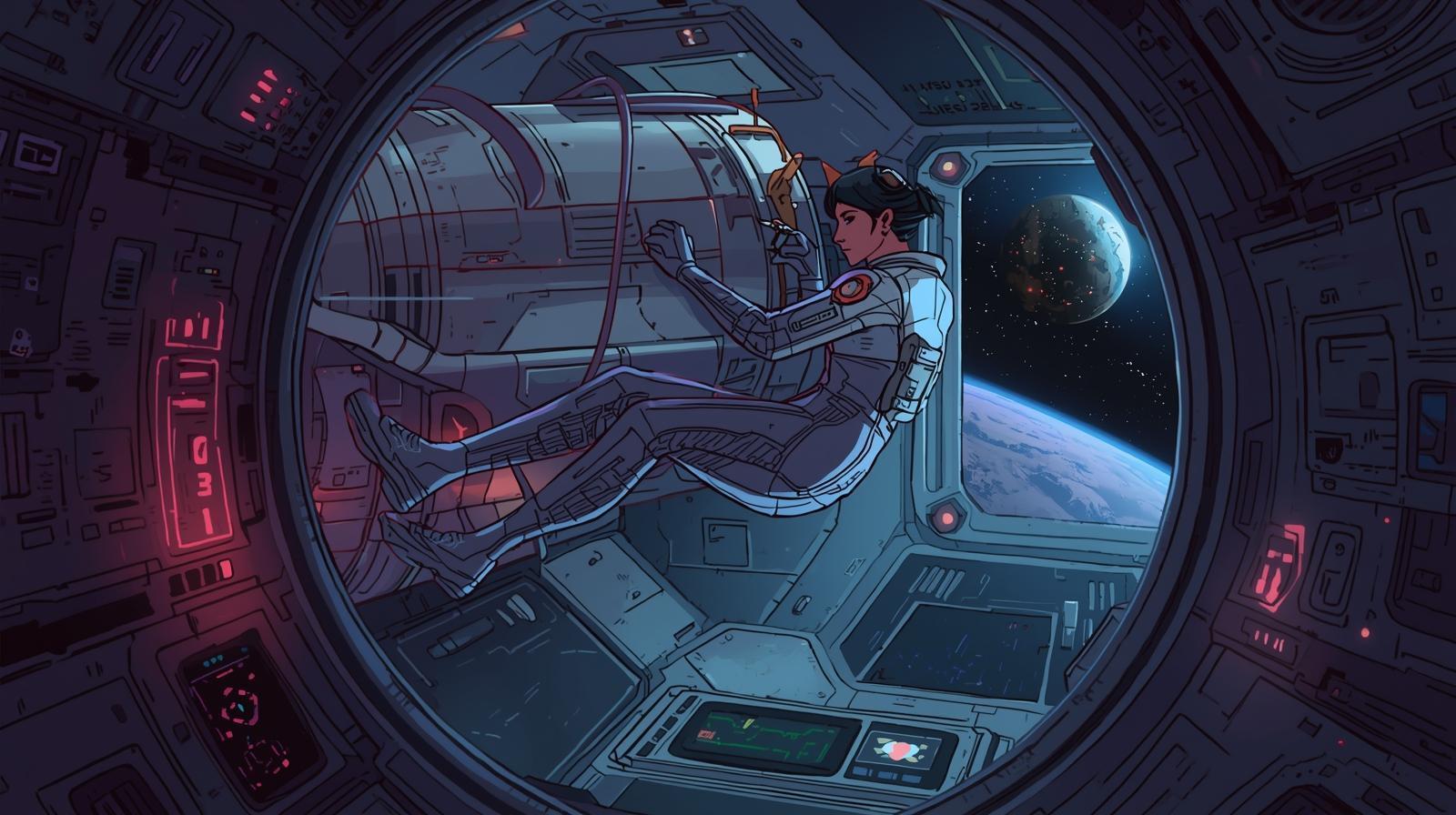
Maya woke to blaring alarms in the deep silence of space. The sound cut through the darkness of her sleep pod like a knife, dragging her from dreams of Earth's blue oceans—oceans she would never see again. As chief engineer of the Horizon, humanity's first colony ship, any alarm meant potential disaster for the ten thousand sleeping passengers who trusted her with their lives and their futures.
She fumbled for her emergency suit in the darkness, her heart already racing. The ship's artificial gravity kept her feet on the floor as she dressed with practiced efficiency. Through the small porthole of her quarters, she could see the endless void of space, punctuated by distant stars that never seemed to move.
"Systems alert! Cryogenic Unit Seven showing temperature fluctuations. Immediate attention required!" the AI announced urgently.
"Acknowledged. I'm suiting up now. Give me a full status report," Maya commanded, her voice still rough from sleep.
Maya's fingers flew across the control panel embedded in the wall of her quarters, pulling up diagnostic screens and system readouts. The numbers made her blood run cold. Unit Seven housed nearly fifteen hundred colonists, including families with children, all dreaming of a new world they would reach in another hundred and thirty years.
"Computer, show me the data on my display screen. How severe is the fluctuation?" Maya commanded, strapping herself into her suit.
"Temperature has risen three degrees above optimal in the past hour. At current rate, passengers will wake prematurely in approximately six hours," the AI calculated.
"Six hours? That's not enough time to print a replacement component. What's causing the malfunction?"
"Analyzing now... preliminary scans indicate pump failure in the primary coolant system."
Maya's heart sank like a stone. They were only seventy years into a two-hundred-year journey to New Earth. Waking now would doom everyone—there wasn't enough food or water for conscious passengers, and the psychological impact of waking to find they were still decades from their destination would be devastating. People had killed themselves for less on the early generation ships.
She pushed off from her quarters and floated through the narrow corridor toward the engineering bay, her magnetic boots clicking into place with each step. The Horizon was a massive cylinder, spinning slowly to create artificial gravity in the outer rings. But here in the core, near the emergency systems, everything operated in zero gravity for efficiency.
"Why didn't the backup cooling system activate automatically? Run a diagnostic immediately!" Maya ordered, floating through the corridor toward the engineering bay.
"Backup system shows green, but primary coolant pump has a microscopic crack from a micrometeorite impact last week," the AI reported.
"Last week? Why wasn't I notified of the impact?"
"The impact registered as minor. Shielding absorbed 99.7% of the kinetic energy. The damage was below reporting threshold."
"Below threshold? We're going to need to revise those parameters if we survive this!"
Maya reached the engineering section and examined the massive cylindrical pump. It was the size of a small car, humming with quiet power as it circulated coolant through the life support systems. The crack was invisible to the naked eye, but sensors confirmed it—a hairline fracture that was slowly growing with each pump cycle, allowing precious coolant to escape atom by atom.
She pulled up the engineering specifications on her tablet, her mind already racing through possible solutions. The pump was a critical component, designed to last the entire journey. Replacing it had never been part of the mission parameters because it should never have needed replacing.
"Computer, can we 3D print a replacement pump in six hours?" Maya asked, already knowing the answer.
"Negative. Current print time for component this size: eleven hours minimum," the AI responded.
"What about emergency patches? Do we have any nano-sealant in inventory?"
"Affirmative. Molecular bonding compound storage shows adequate supplies for a repair attempt."
"Then we need to repair it in place. Show me the molecular bonding compound inventory," Maya decided, her mind racing through possibilities.
For the next four hours, Maya worked at the molecular level, using nano-robots to seal the crack atom by atom. Her hands ached from the precision required, and her eyes burned from staring at the microscopic display. Each nano-robot had to be carefully guided through the metal structure, depositing bonding material and fusing the crack closed at a scale smaller than a human hair.
The work was delicate and exhausting. One wrong move could make the crack worse, could cause a catastrophic failure that would result in explosive decompression. She had to be perfect, and perfection took time they didn't have. Sweat pooled in her suit, making her uncomfortable, but she couldn't stop to adjust anything.
"Maya, you've been working for four hours straight. Your oxygen levels are dropping," the AI warned gently.
"Just ten more minutes. I'm almost finished with the final layer," Maya insisted, sweat dripping inside her helmet.
"Your heart rate is elevated. I recommend a short break."
"No breaks! If I stop now, I'll lose my place in the sequence. Keep monitoring my vitals but don't interrupt again unless it's critical."
"Understood. Temperature in Unit Seven is now stabilizing. Repair appears successful," the AI confirmed with what sounded like relief.
Maya completed the seal and activated the pump. There was a moment of terrible suspense as the system came back online. Then cool air flowed immediately through the circulation system, and within minutes, the cryogenic unit returned to optimal temperature. The danger had passed. Fifteen hundred lives remained safe in their frozen sleep, unaware of how close they had come to disaster.
She leaned against the bulkhead, her body trembling with exhaustion and relief. Through the porthole, she could see the stars wheeling slowly past as the ship continued its endless journey through the void.
"All passengers remain in stable suspended animation. Crisis averted," the AI announced.
"Log this incident and update the maintenance schedule. I want weekly inspections of all critical systems from now on," Maya ordered, exhausted but relieved.
"Acknowledged. Shall I also revise the micrometeorite impact reporting threshold?"
"Yes. Any impact that causes even microscopic structural changes should be flagged for immediate review. No exceptions."
"Updated. Excellent work, Engineer Maya. The colony thanks you, even if they'll never know," the AI added quietly.
"They don't need to know. They just need to arrive safely. That's all that matters."
Maya smiled and made her way back to her sleep pod, knowing she had saved not just lives, but humanity's future among the stars. In another hundred and thirty years, those fifteen hundred colonists would wake up on New Earth, never knowing how close they had come to never arriving at all. She would be long dead by then, but somehow that didn't matter. The mission was everything, and the mission would continue.






No comments yet. Be the first to share your thoughts!