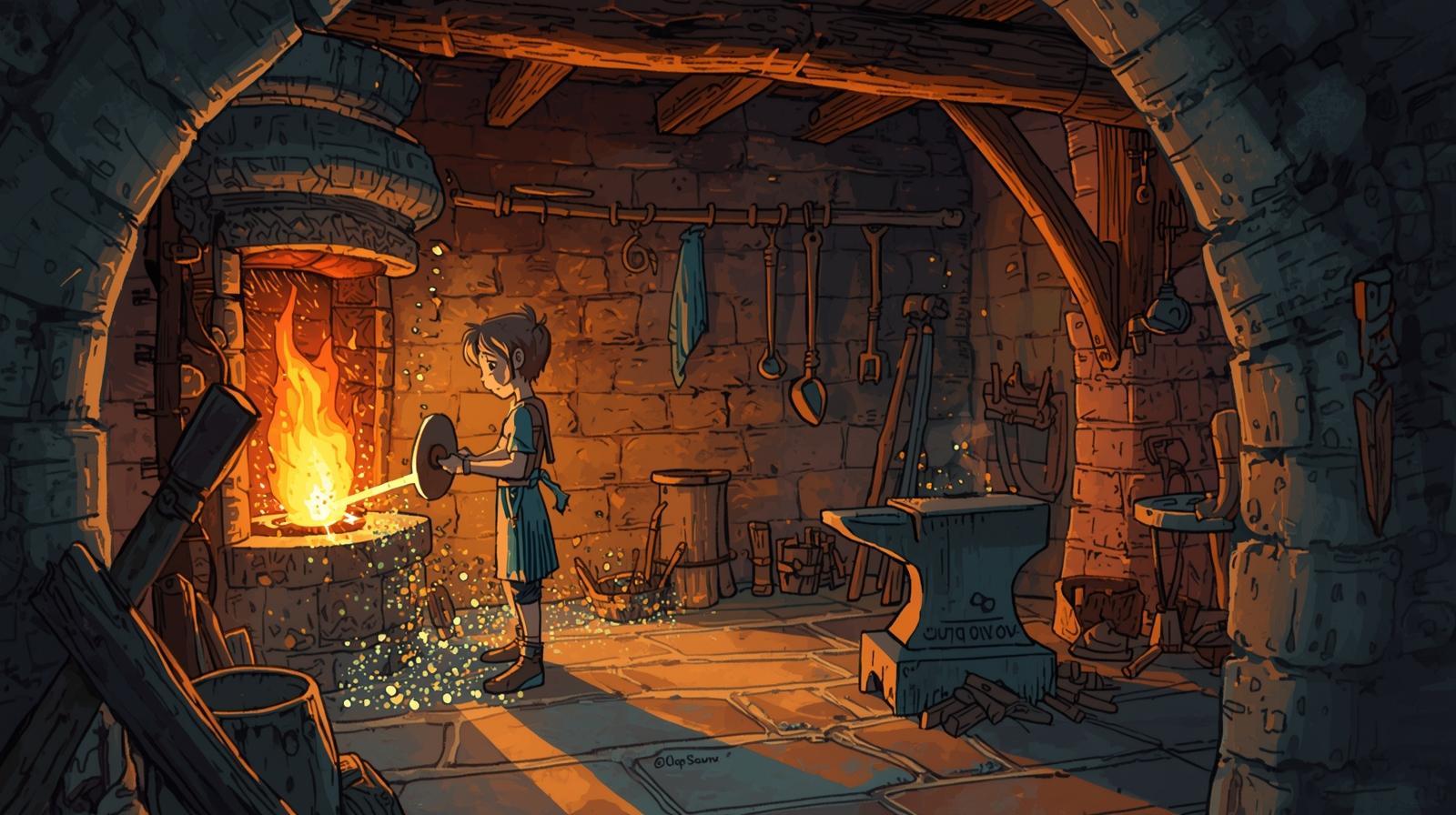
The forge glowed orange in the pre-dawn darkness as fourteen-year-old Thomas pumped the bellows. Master Edmund, the finest blacksmith in all of Yorkshire, had taken him as an apprentice three months ago. The heat from the forge washed over Thomas's face, making his skin prickle with sweat despite the cool morning air. Outside, the village of Ashford was still sleeping, unaware that another day of backbreaking work had already begun in the smithy.
Thomas had dreamed of becoming a blacksmith since he was a small child, watching in awe as the village smith transformed raw metal into tools, weapons, and works of art. But the reality of apprenticeship was far different from his childhood fantasies. His arms ached from pumping the bellows, his hands were covered in burns, and he still hadn't been allowed to touch a piece of hot metal.
"Steady now, boy! The fire must breathe like a living thing. Too much air ruins the steel, too little leaves it weak," Master Edmund instructed, his weathered hands shaping a horseshoe.
Thomas watched his master work with practiced efficiency. Edmund's movements were fluid and precise, the result of forty years at the forge. Every strike of the hammer had purpose, every turn of the metal calculated. He made it look effortless, but Thomas knew better. He had tried to lift one of those hammers once and could barely swing it.
"Yes, Master Edmund. But when will you teach me to forge a sword? I've been pumping these bellows forever!" Thomas complained, sweat dripping from his forehead.
"Forever? You've been here barely three months, Thomas. A master blacksmith trains for seven years. Patience is the first skill you must learn," Edmund replied without looking up.
"Seven years? But Master, I already know how to keep the fire hot! What more is there to learn from just watching?"
"Everything, boy. You're learning to read the metal, to understand its moods. Watch how the color changes. Listen to the sound it makes. These are the secrets that can't be taught, only learned."
Days turned into weeks. Thomas swept the workshop, hauled coal from the storage shed, and tended the fire with monotonous regularity. He watched enviously as Master Edmund crafted beautiful tools and weapons for the local lord. Each piece was a work of art—plowshares that would turn the earth for generations, knives that would keep their edge for decades, and swords that sang when they cut through the air.
The workshop itself was a place of constant noise and heat. The ring of hammer on anvil, the hiss of hot metal in water, the roar of the forge—these sounds became the rhythm of Thomas's days. He learned to read the color of the metal, to understand when it was too hot or too cold, to recognize the subtle differences in sound that indicated perfection or failure.
"Master, the lord's steward is here with an urgent request!" Thomas announced one morning as a well-dressed man entered.
The steward was a thin man with sharp eyes and expensive clothes. He looked around the smithy with barely concealed disdain, as if the honest work done here was beneath his notice. But his message was important enough to bring him here personally.
"Good morning, Master Edmund. Lord Ashford requires a special ceremonial sword for the King's visit next week. It must be your finest work," the steward declared.
"A week? Such a blade requires careful planning and precise execution. Tell his lordship I shall begin immediately," Edmund agreed, though worry creased his brow.
"The payment will be generous, of course. Lord Ashford expects nothing less than perfection."
"He shall have it. The sword will be ready in time for the ceremony," Edmund promised.
That night, Edmund fell ill with fever. Thomas sat by his bedside in the small room above the smithy, concerned for his master's health. The old man's skin was hot to the touch, and he shivered despite the blankets piled on top of him. The village physician had come and gone, leaving bitter herbs and grave warnings.
Thomas had never seen his master look so weak. Edmund had always been a pillar of strength, working from dawn until dusk without complaint. Now he could barely lift his head from the pillow. The reality of the situation settled over Thomas like a heavy cloak—if Edmund couldn't work, the sword wouldn't be made, and Lord Ashford's displeasure could ruin them both.
"Thomas, you must help me. The lord's sword... I cannot forge it in this condition," Edmund whispered weakly.
"But Master, I don't know how! I've never made anything but nails!" Thomas protested, fear in his voice.
"You've watched me every day. Remember: heat the steel to orange, fold it twelve times for strength, and temper it in oil, not water. Trust what you've learned," Edmund encouraged.
"What if I fail? What if I ruin the steel? Lord Ashford will be furious!"
"Then you'll start again. Every master has ruined steel, Thomas. The difference is that masters learn from their mistakes and continue. Now go, before we lose more time."
With trembling hands, Thomas worked through six days and nights. He heated, folded, and hammered the steel exactly as he'd observed. The work was harder than he had ever imagined. His shoulders screamed in protest, his hands blistered and bled, and more than once he collapsed in exhaustion only to force himself back to the forge after an hour of rest.
When mistakes happened, he started over rather than rushing. He ruined three attempts before the fourth began to take shape. Each failure taught him something new—how to read the metal, how to control the temperature, how to judge when the steel had been folded enough. The knowledge that had seemed so mysterious when Edmund worked now began to make sense in his hands.
"The blade curves slightly. I must reheat and straighten it perfectly," Thomas muttered to himself on the fifth night.
On the seventh day, Thomas presented the finished sword. The blade gleamed silver, perfectly balanced, with intricate patterns in the steel from the folding. It wasn't perfect—a master's eye could see the slight irregularities, the places where his inexperience showed. But it was good. Far better than anyone could expect from a boy of fourteen with only three months of training.
Edmund had recovered enough to sit up in bed. His fever had broken during the night, and though he was still weak, his eyes were clear and focused. He examined the sword with the critical eye of a master craftsman, running his fingers along the blade, testing the balance, checking the edge.
"Master Edmund! I finished it! Look, the edge is sharp enough to cut silk!" Thomas exclaimed, his eyes shining with pride.
"You did well, my boy. You learned patience through watching, and mastery through necessity. This is how a true craftsman is born," Edmund smiled weakly from his bed.
"Does this mean I can start making swords now, Master?"
"It means you've taken your first real step. There are still thousands more to take. But yes, I think it's time to teach you properly."
"I understand now, Master. The bellows taught me rhythm, the fire taught me observation, and this sword taught me patience," Thomas reflected.
"And what is the most important lesson of all?"
"That mastery comes not from rushing, but from dedication. That every mistake is a teacher, not a failure."
"Good. You're learning, Thomas. You're truly learning."
When the King himself praised the sword's quality during the ceremony at Lord Ashford's manor, Thomas learned that greatness comes not from rushing to glory, but from years of patient dedication to one's craft. He stood in the back of the great hall, still wearing his apprentice's apron, and watched as the King held the sword aloft for all to see.
Edmund had insisted that Thomas take credit for the work, but Thomas had refused. The sword had been made possible by seven years of Edmund's teachings, condensed into three desperate months and six impossible days. The real master was the one who had shown him the way, even from a sickbed. And Thomas knew that he still had years of learning ahead of him before he could truly call himself a blacksmith.




No comments yet. Be the first to share your thoughts!